The Gospel of the day is the passage selected for a church service on a particular date. There is no single reading shared by all churches: Catholic, Protestant, and Orthodox communities follow different lectionaries, or schedules of Scripture readings. For today’s passage, use your church’s calendar; below are places to look, an explanation of the cycles, and a chapter-a-day plan for reading all four Gospels in 89 days.
Where to find today’s Gospel reading
For Catholic daily Mass readings in the United States, start with the USCCB daily readings. For churches using the Revised Common Lectionary, the Vanderbilt lectionary site explains the schedule and its daily readings. For Orthodox readings, check Orthocal or the Greek Orthodox Archdiocese’s Online Chapel.
Choose the calendar your parish follows. Even within Orthodoxy, the same civil date can have different readings under the old and new calendars. A feast or a local observance can also change the selection, so your parish’s schedule is the best guide if you are preparing for a service.
How the reading cycles work
A lectionary brings Scripture into the rhythm of the church year. It is different from a plan that takes you through a book from beginning to end.
| Tradition | Main cycle | Where the Gospels fit |
|---|---|---|
| Roman Catholic | Sundays: three years, A, B, and C. Weekday first readings in Ordinary Time: two years, I and II. | Sunday readings emphasize Matthew in A, Mark in B, and Luke in C. John appears during the Easter season and at other points, including John 6 in Year B. The weekday Gospel cycle repeats annually. |
| Revised Common Lectionary | Three-year Sunday cycle, A, B, and C, used by many mainline Protestant churches. | Typically an Old Testament reading, a psalm, an Epistle, and a Gospel. Daily readings accompany the Sunday cycle. |
| Byzantine Orthodox | Annual cycle beginning at Pascha, or Easter. | John and Acts after Pascha; Matthew after Pentecost, with Mark on later weekdays; Luke in the fall; Mark again on winter weekdays and much of Lent’s weekends. |
Sources: the Catholic Lectionary for Mass, Vanderbilt’s RCL FAQ, and the Orthodox annual reading guide (in Russian).
Many Orthodox churches adjust the start of Luke’s readings to the Monday after the Sunday following the feast of the Exaltation of the Cross. This is called the Lukan jump. The calendar and this adjustment both matter. On October 5, 2026, Orthocal lists Luke 6:24–30 on the new calendar and Luke 3:19–22 on the old calendar. Ukrainian churches on the new calendar don’t use the jump and read Luke 4:37–44 that day.
On ordinary Orthodox Lenten weekdays, there is usually no full Divine Liturgy, and the Liturgy of the Presanctified Gifts has no ordinary Epistle or Gospel reading. Isaiah, Genesis, and Proverbs are read instead. Feasts and the first three days of Holy Week have exceptions. Revelation is not read at the Divine Liturgy.
Why daily passages do not replace a whole Gospel
A short passage can stay with you through the day. But a lectionary follows seasons and feasts, rather than the narrative order of a book. You may hear a passage about the Resurrection, then return to an earlier part of Jesus’ ministry.
Reading a Gospel straight through lets you follow its own story: how Jesus meets people, teaches, travels toward Jerusalem, and faces his death and Resurrection. You can keep your church’s daily reading and read a chapter alongside it.
Read all four Gospels in 89 days
Matthew has 28 chapters, Mark 16, Luke 24, and John 21: 89 chapters altogether. One chapter a day takes just under three months. Here is one order that starts with the shortest Gospel:
| Days | Gospel | Chapters |
|---|---|---|
| 1–16 | Mark | 1–16 |
| 17–44 | Matthew | 1–28 |
| 45–68 | Luke | 1–24 |
| 69–89 | John | 1–21 |
You can also begin with Matthew and use the usual Bible order. If Scripture is new to you, try our first week with John. For the rest of the New Testament, see our New Testament reading guide; for keeping the habit, see daily Bible reading.
In Bible Garden, the four Gospels take 7.7 hours in the Berean Standard Bible (BSB), read by Bob Souer—an average of 5.2 minutes per chapter. BSB with David takes 8.5 hours, averaging 5.7 minutes; the World English Bible (WEB) with Winfred Henson takes 8.3 hours, averaging 5.6 minutes. These are recording lengths without added pauses, measured from the app’s recordings on October 4, 2026; individual chapters vary.
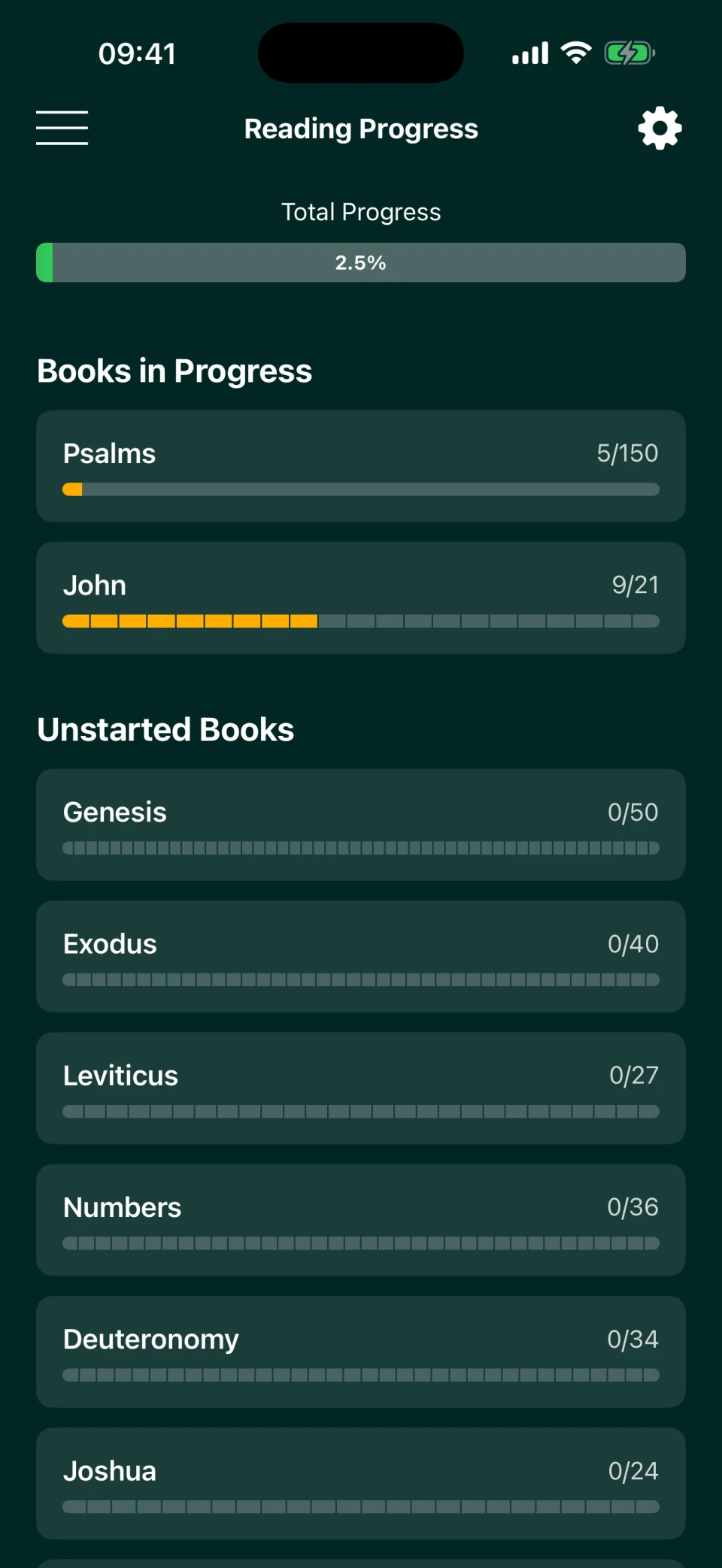
Bible Garden has no built-in reading plans, so keep the table handy. By default, a chapter counts as read after you listen to 90% of its audio or scroll to the end of its text. The progress screen shows books in progress and books completed; see how the reading tracker works.
Listen to a passage at your own pace
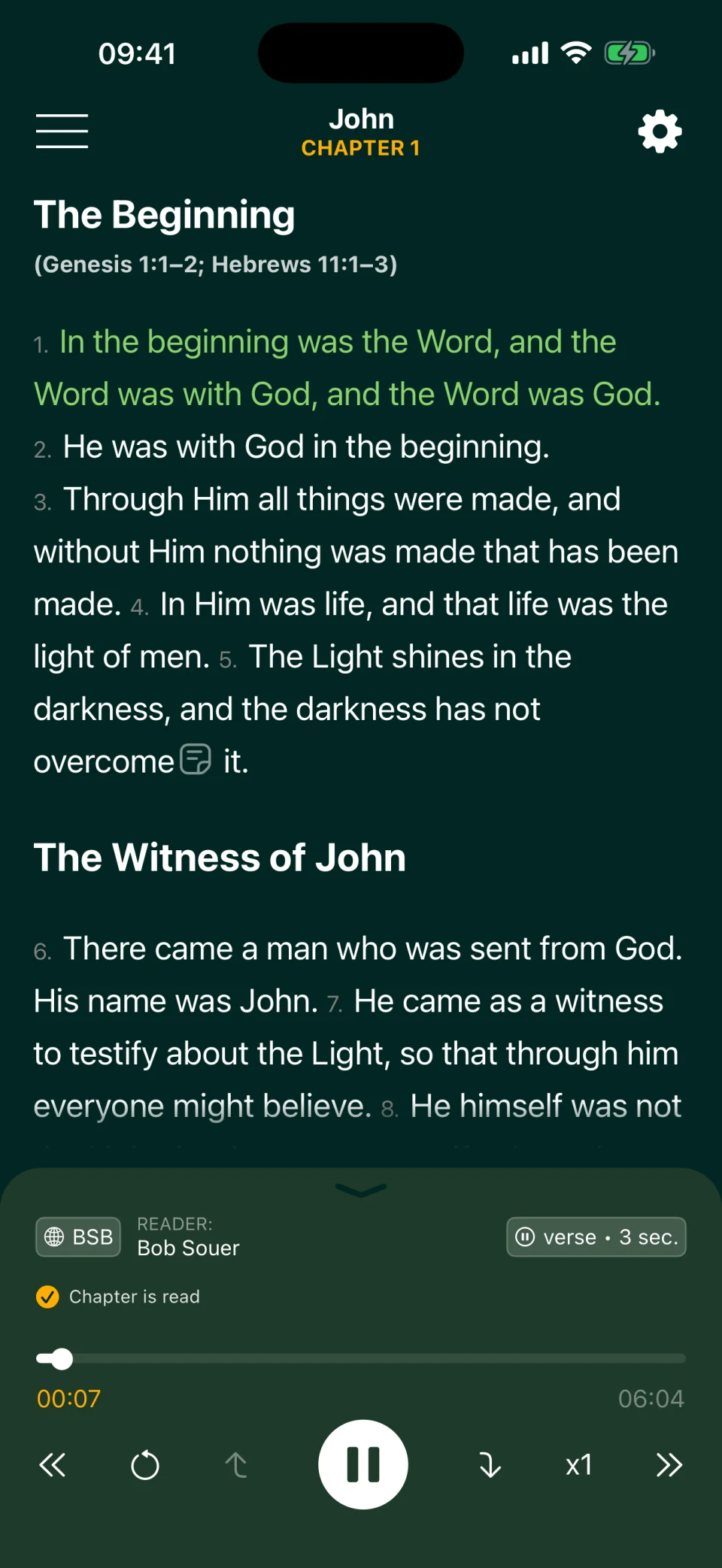
To hear a passage in Bible Garden on iPhone or iPad, open its book and chapter. While playback is stopped, use the previous/next verse arrows to highlight the starting verse, then press Play. Pause when you reach the end of the passage. There is no link that automatically opens today’s Gospel in the app.
The spoken verse is highlighted and the text scrolls with it. Jesus’ words appear in color—see what red-letter Bibles show. You can add a timed pause, or a stop until you press Play, after each verse, paragraph, or section.
Choose BSB with Bob Souer or David, or WEB with Winfred Henson. You can hear a voice sample before choosing; our narrator guide has more detail.
Multi Reading is Bible Garden’s distinctive feature. Set up BSB, a short pause, and WEB: each verse plays first in one translation, then in the other, with both texts on screen. Hearing the same verse in different words gives you time to notice it before moving on. Each reading step has its own speed setting.
For another approach, pair English BSB with Russian Synodal in a Gospel such as John 1; see reading the Bible in two languages. For English translation choices, see which Bible translation to choose. Bible Garden is free, with no ads or purchases. A web app and an Android version are in our plans.
Frequently asked questions
What is today’s Gospel reading?
It depends on your church’s lectionary and calendar. Use the USCCB for US Catholic Mass readings, Vanderbilt for the Revised Common Lectionary, or your Orthodox parish’s calendar and the resources above. This page doesn’t show a daily reading.
Do Catholic weekday readings repeat every year?
The weekday Gospel cycle repeats annually. In Ordinary Time, the first reading follows a two-year cycle, Year I and Year II. In Advent, Christmas, Lent, and the Easter season, weekday readings follow an annual cycle. Sundays use the separate three-year A/B/C cycle. Feast days can have their own readings.
Is the Revised Common Lectionary only for Sundays?
Its main three-year cycle is for Sundays and festivals. There are also daily readings associated with that cycle; Vanderbilt explains how they relate to the Sunday passages. Check which schedule your congregation uses.
Why do Orthodox calendars sometimes show different passages?
Fixed feasts may follow different calendars, and churches may apply different adjustments to the reading cycle, including the Lukan jump. Saints’ commemorations and local observances can also affect the readings.
Can I listen offline in Bible Garden?
Audio playback requires an internet connection. The app does not currently let you download recordings for offline listening.
Can I finish all four Gospels in 90 days?
Yes. They contain 89 chapters, so one chapter a day takes 89 days. Start with Mark for the shortest book, or with our introductory week in John if you are new to the Bible.