There is no single best Bible translation. The Bible was written in Hebrew, Aramaic, and Greek; an English rendering reflects how its translators understood those texts. Choose a version that fits what you are doing—reading for the first time, studying closely, or following the wording familiar in your church—and one you simply like. Comparing translations can bring out more of a passage than either reading alone. Here is a guide to English versions and to hearing two of them in the free Bible Garden app for iPhone and iPad.
Word for word or thought for thought?
Translation choices fall along a spectrum:
- Word-for-word (formal) translations stay closer to the wording and structure of the source text. They can help you notice repeated words, but may sound stiff or leave an unfamiliar expression unexplained.
- Thought-for-thought (dynamic) translations express the sense in natural English. They are easier to follow, but make more interpretive choices on the reader’s behalf.
Neither approach removes interpretation. At the far freer end is a paraphrase, useful for hearing a familiar passage afresh but less useful for checking its wording. A translation’s place on this spectrum is a guide, not a measure of its worth.
English Bible translations at a glance
The table moves roughly from word-for-word to thought-for-thought. Versions near each other can still differ because of source texts, editorial choices, and style.
| Translation | Approach | What to expect | In Bible Garden? |
|---|---|---|---|
| New American Standard Bible (NASB) | Word-for-word | Close attention to wording; sometimes stiff English | No |
| English Standard Version (ESV) | Word-for-word | Literary English with a relatively formal approach | No |
| New King James Version (NKJV) | Word-for-word | KJV tradition in updated English | No |
| King James Version (KJV) | Word-for-word | Influential 17th-century English; some words now have different meanings | No |
| World English Bible (WEB) | Word-for-word | Modern update of the 1901 American Standard Version | Yes: American and British editions |
| Christian Standard Bible (CSB) | Middle | A stated balance of accuracy and readability | No |
| Berean Standard Bible (BSB) | Near the middle, in its publisher’s words | Contemporary English that reads smoothly while retaining textual detail | Yes |
| New International Version (NIV) | Middle | Natural English with a balance of wording and sense | No |
| New Living Translation (NLT) | Thought-for-thought | Accessible phrasing, with more of the meaning expressed for you | No |
| The Message | Paraphrase | Very idiomatic retelling; best read alongside a translation | No |
Sources: CSB’s translation spectrum, Berean Bible on its approach and public-domain terms, World English Bible, and background on KJV, NKJV, NASB, ESV, NIV, NLT, and The Message (checked September 28, 2026).
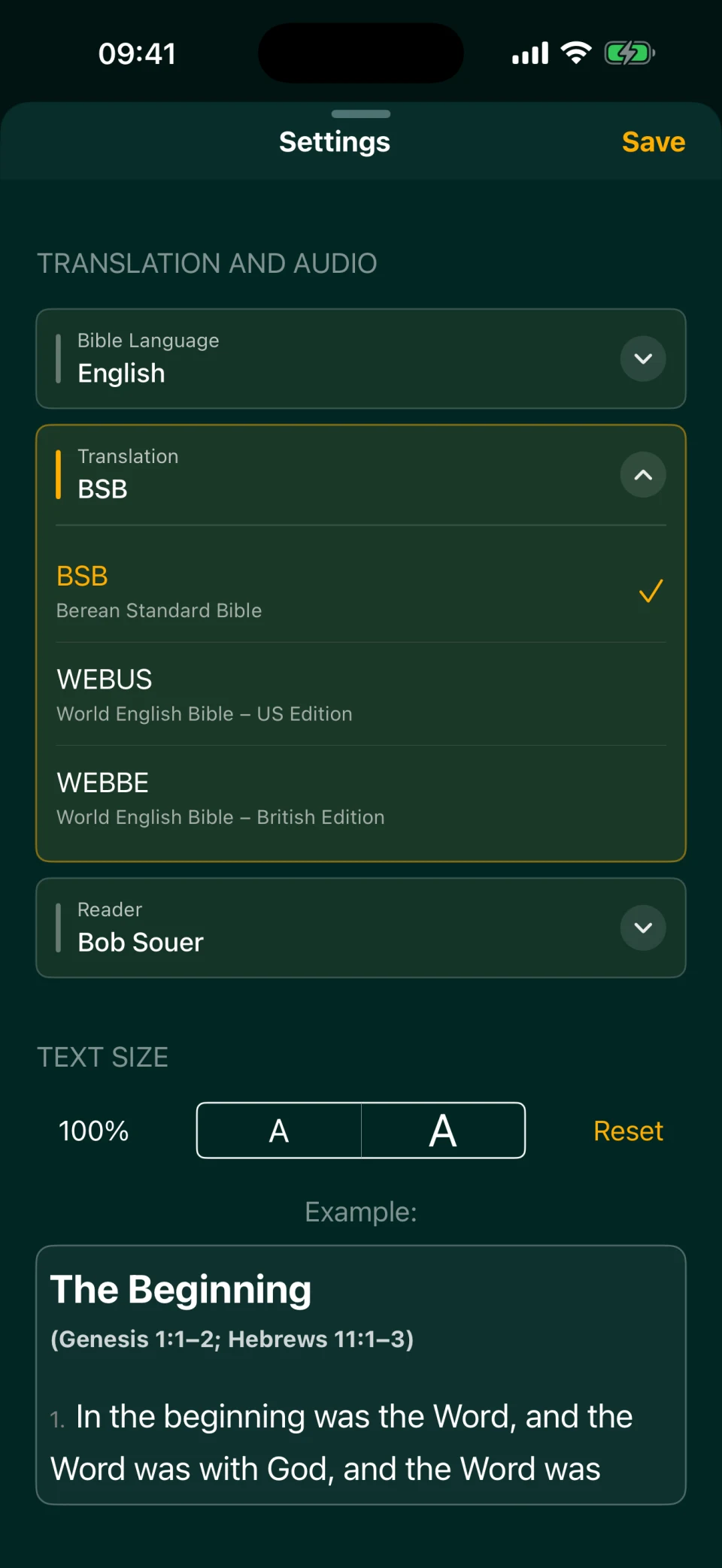
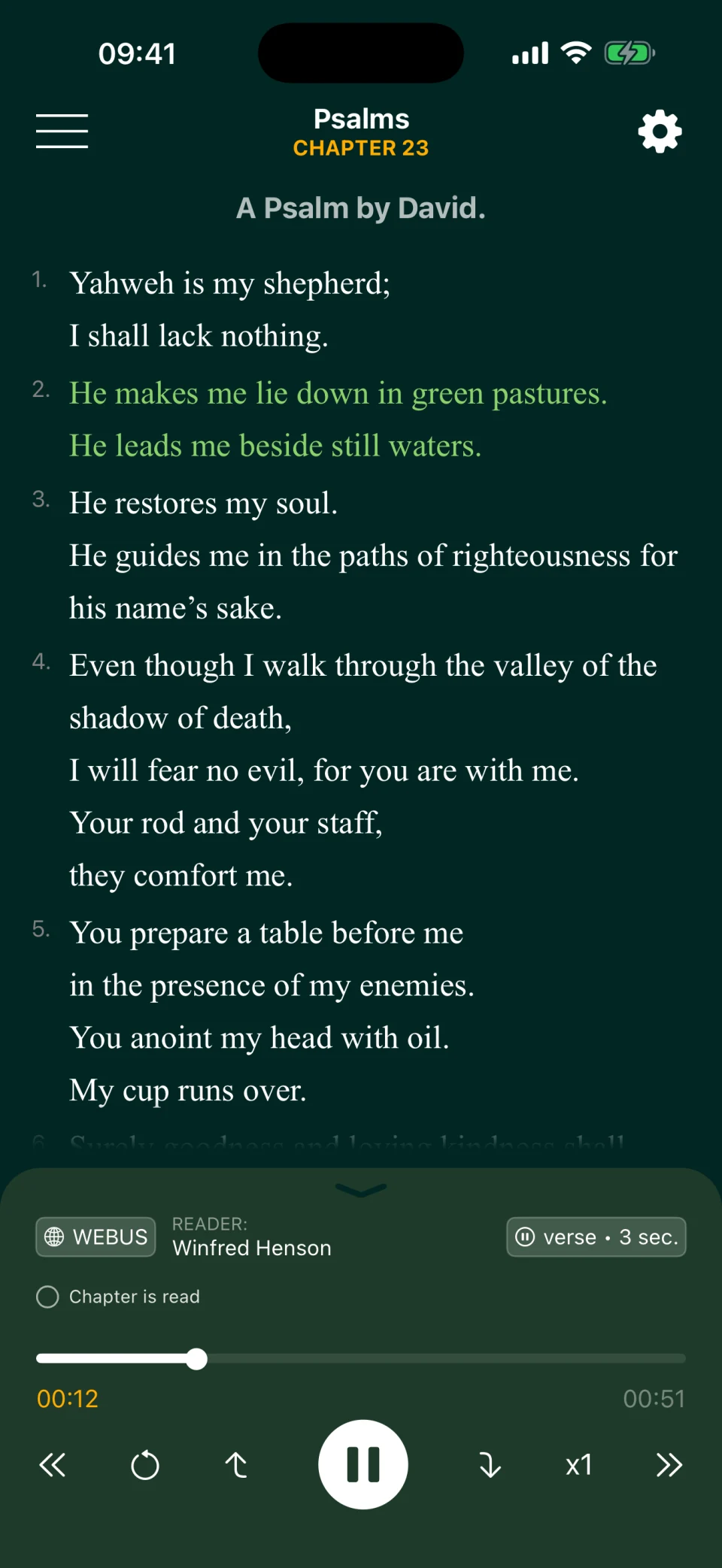
BSB and WEB are the two English translations in Bible Garden. BSB’s publisher places it “near the middle of the range” between word-for-word and thought-for-thought; it has been in the public domain since April 30, 2023. WEB is also public domain. It updates the American Standard Version of 1901 and uses the Byzantine Majority Text for its New Testament. The app includes the American edition, read by Winfred Henson, and the British edition (WEBBE), whose narrator is not named.
The canon matters as well as the wording. Catholic editions such as the NABRE, Orthodox editions, and some ecumenical editions of the NRSV include books beyond the 66 in most Protestant Bibles; their contents are not identical. Bible Garden has 66 books and does not include the additional books. If you need your church’s canon, check the edition’s table of contents.
Compare translations to understand more
When two translations differ, pause and look again. A word in the original may carry more than one sense, manuscripts may vary, or translators may understand a sentence differently. For instance, the KJV says in John 1:5 that the darkness “comprehended it not”; modern versions often say it has not “overcome” the light. The Greek verb can mean both “grasp” and “overcome.” Reading more than one rendering makes that choice visible.
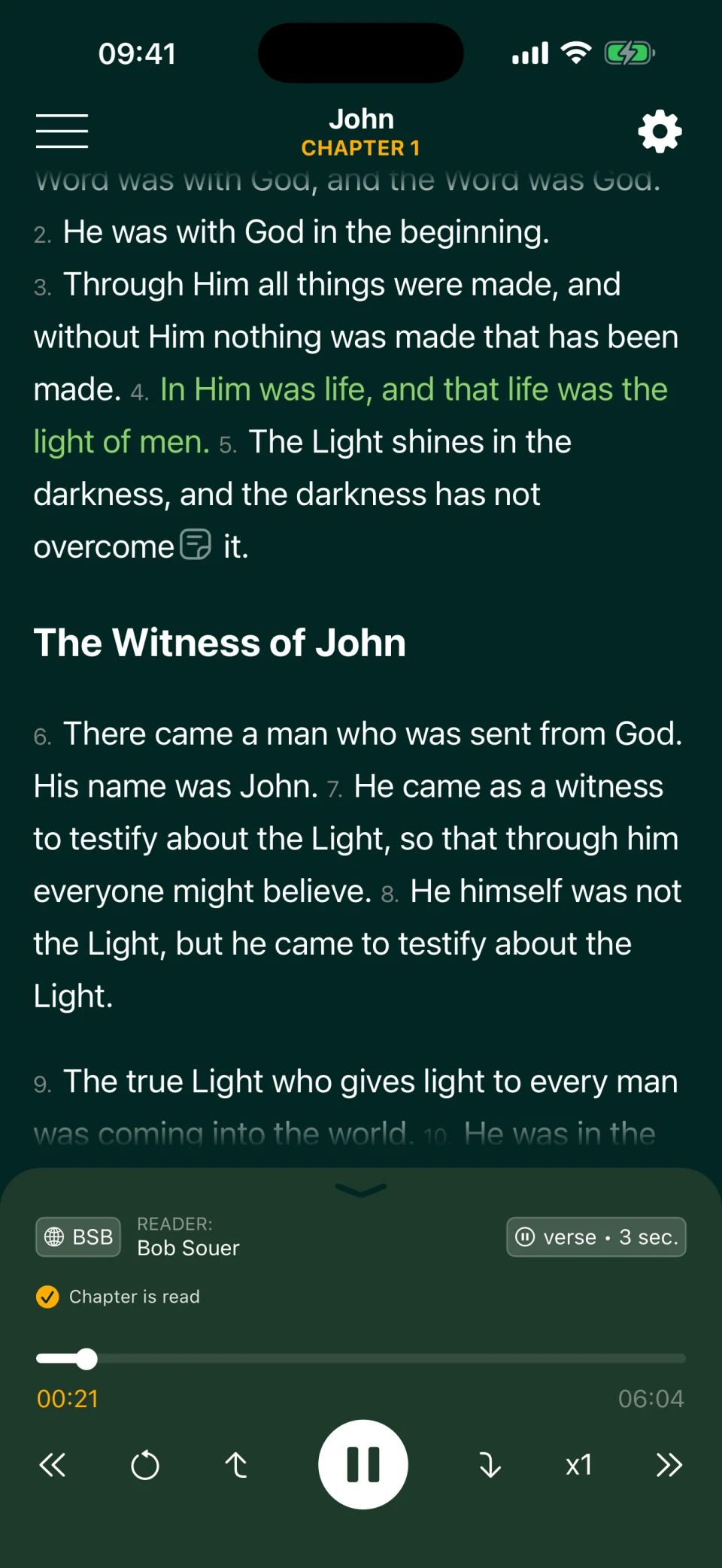
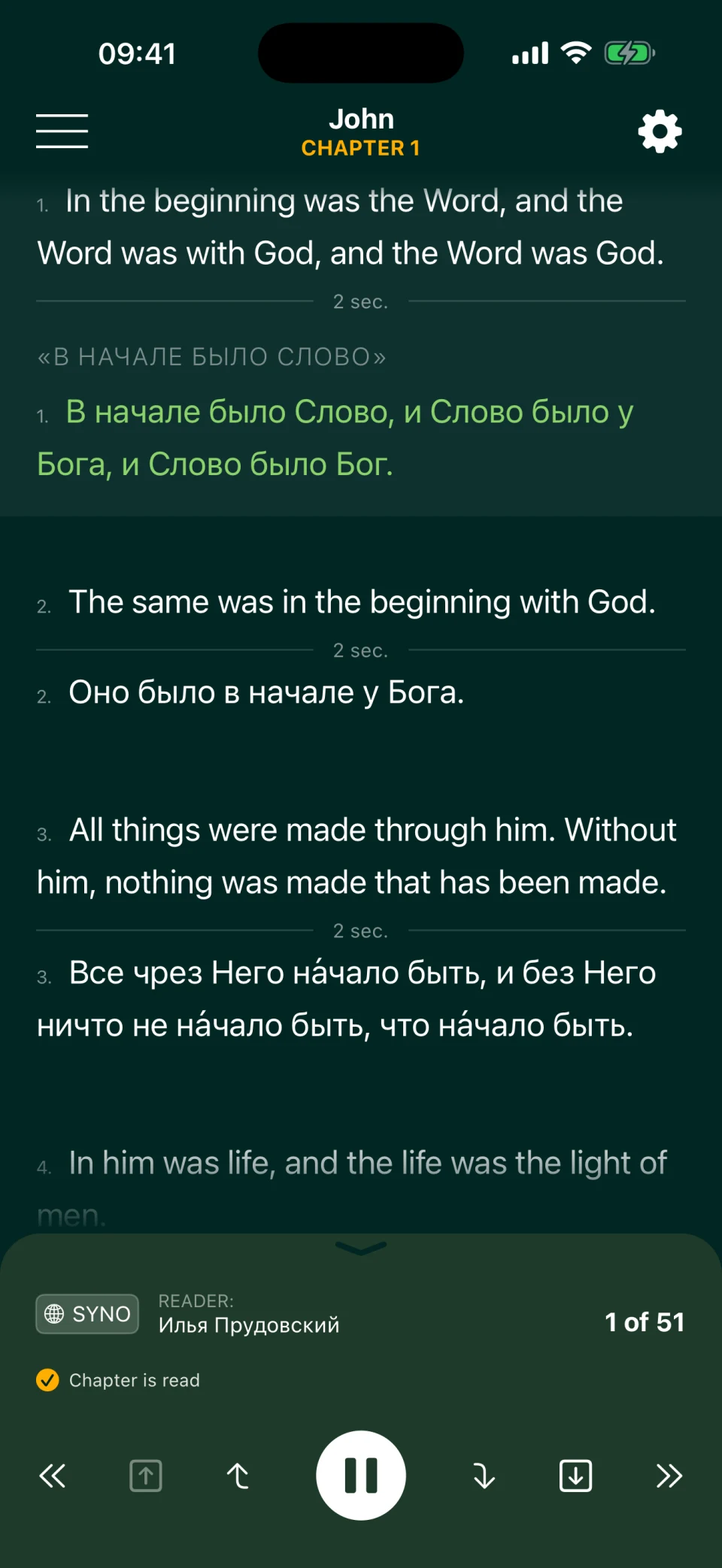
Hear translations side by side in Bible Garden’s Multi Reading. Set up two, three, or more readings, in English or across languages. Each verse plays in one translation and then, after an optional pause, in the next. The same verse appears in all selected translations on screen, with the one playing highlighted.
Listen to John 1:1–5 below: Berean Standard Bible, read by Bob Souer, followed by World English Bible (American edition), read by Winfred Henson. In verse 2, listen for “He was with God in the beginning” beside “The same was in the beginning with God.” Verse 3 also divides the thought differently. Let the pair play slowly enough to notice the wording.
Listen to John 1:1–5 in two translations
A Berean Standard Bible (BSB) · Bob Souer
B World English Bible (WEB) · Winfred Henson
- 1
In the beginning was the Word, and the Word was with God, and the Word was God.
In the beginning was the Word, and the Word was with God, and the Word was God.
- 2
He was with God in the beginning.
The same was in the beginning with God.
- 3
Through Him all things were made, and without Him nothing was made that has been made.
All things were made through him. Without him, nothing was made that has been made.
- 4
In Him was life, and that life was the light of men.
In him was life, and the life was the light of men.
- 5
The Light shines in the darkness, and the darkness has not overcome it.
The light shines in the darkness, and the darkness hasn’t overcome it.
How to compare two translations in the app
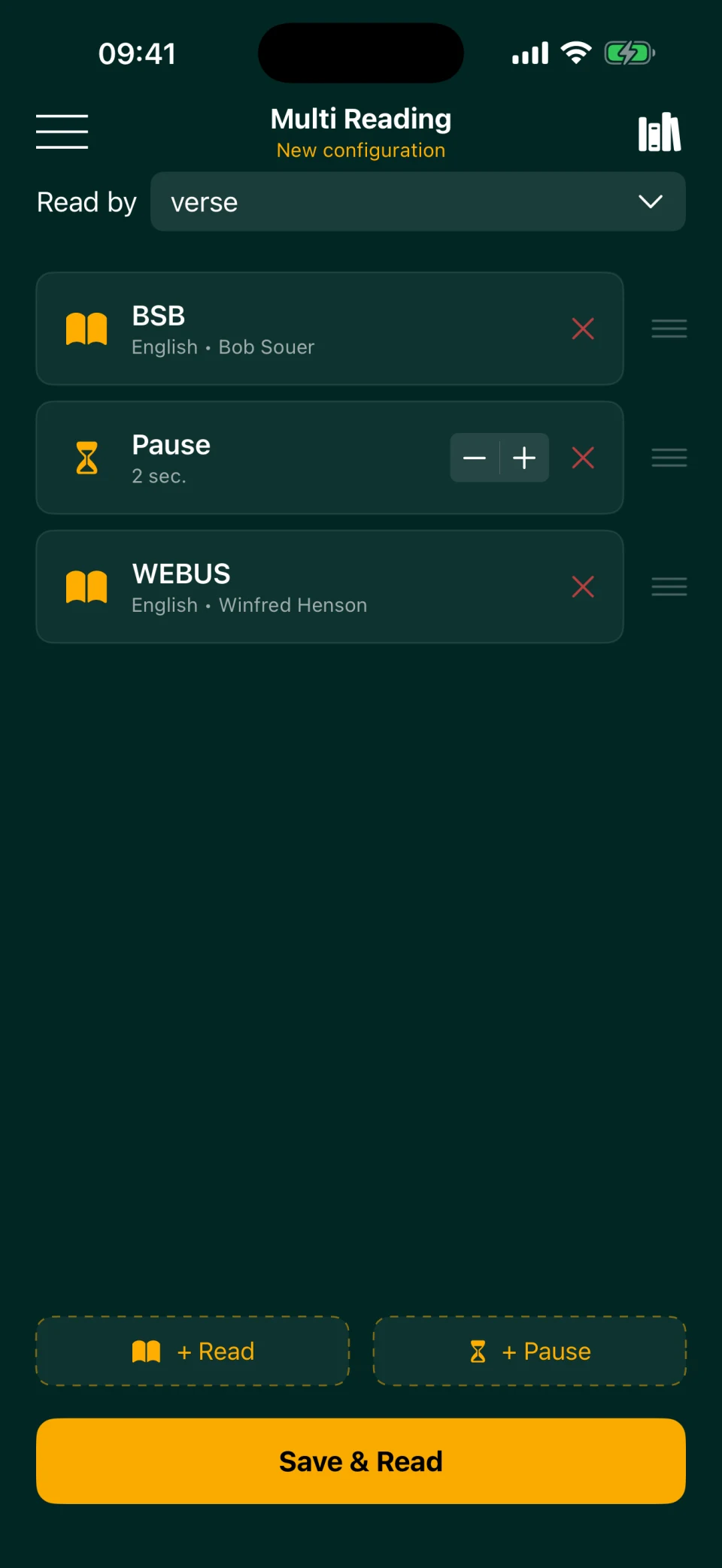
- Open Multi Reading and create a new setup.
- Add a reading with the Berean Standard Bible and Bob Souer.
- Add a pause; two seconds is a useful starting point.
- Add a second reading with the World English Bible, American edition, and Winfred Henson.
- Choose whether the readings alternate by verse, paragraph, section, or chapter. Verse by verse makes differences easiest to hear.
Use the previous and next verse controls to return to a phrase that caught your attention. A setup can also include a third translation, and you can rearrange its reading steps.
The narrator matters too
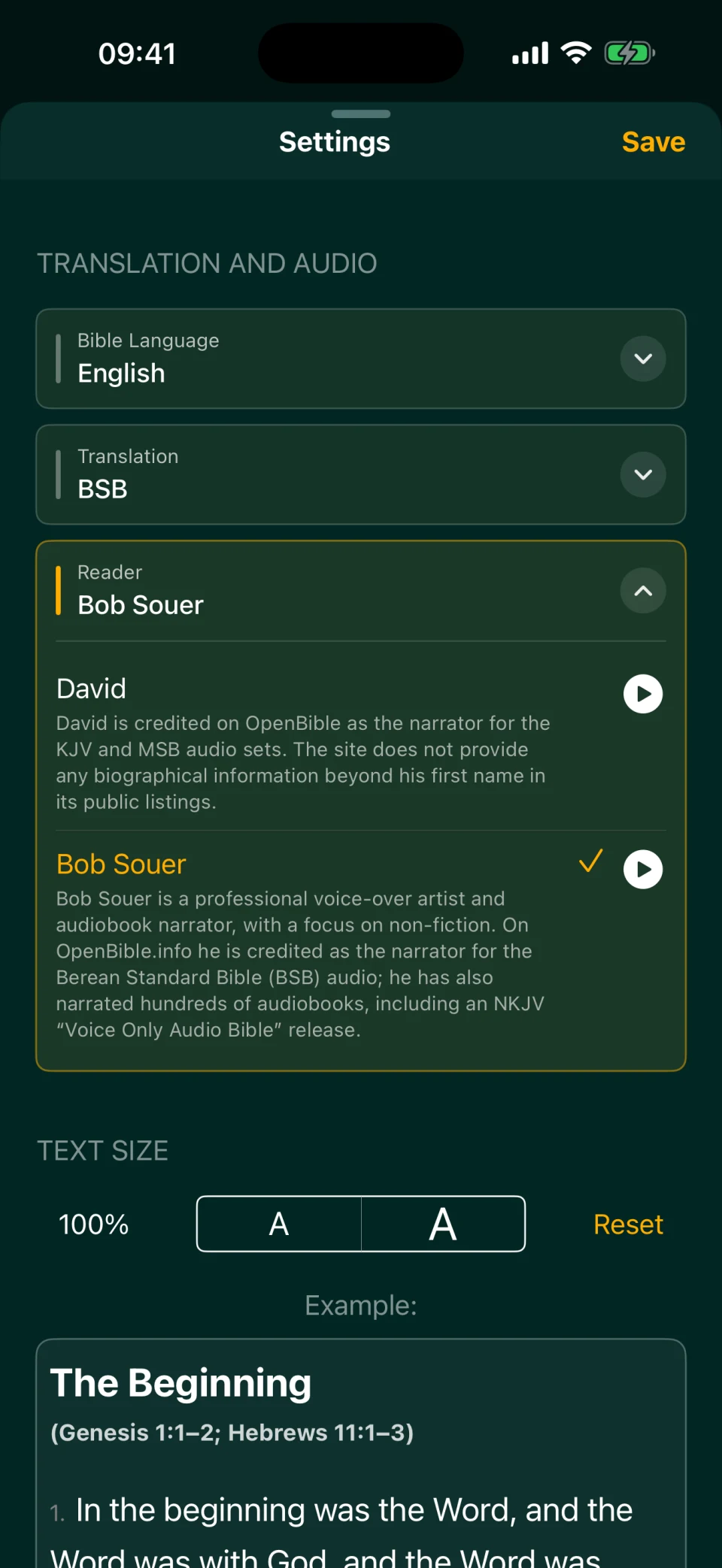
When you listen, the voice is part of the experience. Bible Garden lets you preview a narrator with John 1:1–3 before choosing. BSB has recordings by Bob Souer and David; the American WEB is read by Winfred Henson. The British WEB edition (WEBBE) has a narrator whose name is not listed. Each of these English recordings covers all 66 books.
How to choose your translation
- For a first read, try a version whose sentences you can follow without stopping at every line. NIV, CSB, or NLT may suit you; in Bible Garden, start with BSB and see how it sounds to you.
- For close study, compare a more formal version such as NASB, ESV, or WEB with one that reads more freely. Notice where they agree as well as where they differ.
- For familiar church wording, use the translation your community quotes, whether that is KJV, NKJV, NIV, or another version, and consult a second one when a phrase is unclear.
- For your own taste, choose the language you want to return to. Enjoying the sound of a translation is a good reason to read it.
Whatever you choose, take your time. A chapter read slowly, with room to revisit a difficult verse, may give you more than several chapters skimmed. If you would like a place to begin, try our first week in John or year-long reading plan.
Bible Garden has only a few translations, but each text and recording is hand-picked for its quality and sound. It also has Russian and Ukrainian translations for readers of those languages. The app is available on iPhone and iPad; listening on the website and an Android app are in our plans.
Frequently asked questions
Which Bible translation is best?
No one translation is best for everyone. Try a version you enjoy reading, then compare it with another when a passage raises questions. A formal translation can help you follow wording closely; a thought-for-thought one may make the sense easier to hear.
What Bible translation is most accurate?
Accuracy can mean staying close to the original words or conveying their sense clearly. NASB and ESV lean toward the wording; NIV and CSB balance wording and readability. No English version reproduces every nuance of Hebrew, Aramaic, and Greek, so comparing two translations helps with difficult passages.
What is the easiest Bible translation to read for beginners?
NLT uses accessible, thought-for-thought English; NIV and CSB offer a middle path. If you want to listen in Bible Garden, try its BSB recording and compare a verse with WEB when the meaning is unclear. The easiest version for you is one whose language keeps you engaged.
What is the best Bible translation for study?
Use at least two approaches: for example, read the more formal NASB or WEB beside the NIV or BSB. Differences can show where a word or sentence calls for closer attention. For detailed word study, consult the Hebrew or Greek text and a reliable commentary rather than treating any English version as a word-for-word substitute.
Is it better to read NIV or KJV?
Choose NIV if you want contemporary English; choose KJV if its historic language is familiar and meaningful to you. KJV words sometimes carry a different meaning today, so checking a modern translation can help. Neither NIV nor KJV is in Bible Garden; its English choices are BSB and WEB.