A Bible in two languages can help you follow a passage with someone who speaks another language, or notice what changes between translations. A parallel Bible places two or more translations together; a bilingual Bible pairs the same text in two languages. An interlinear Bible is different: it places a word-by-word translation beneath the Hebrew or Greek original. In the free Bible Garden app for iPhone and iPad, you can read and hear verses in English, Russian, or Ukrainian, with several translations in one sequence. Here is how it works and which recordings you can choose.
Parallel, bilingual, and interlinear Bibles: what's the difference?
| Format | What you see | Why use it | In Bible Garden |
|---|---|---|---|
| Parallel Bible | Two or more translations of the same passage together, in one language or several | Compare how translators handle a difficult verse | Yes: translations appear and play in sequence, verse by verse |
| Bilingual Bible | The same passage in two languages, verse alongside verse | Follow a second language or read with a bilingual family | Yes: pair English with Russian or Ukrainian, or Russian with Ukrainian |
| Interlinear Bible | Hebrew or Greek words aligned with a word-by-word translation | Examine the wording of the original text | No; specialized sites such as BibleHub offer interlinear texts |
These formats answer different questions. Parallel and bilingual readings let you compare the sense of a verse; an interlinear text helps you examine individual words in the original language.
Multi Reading: hear each verse in another language
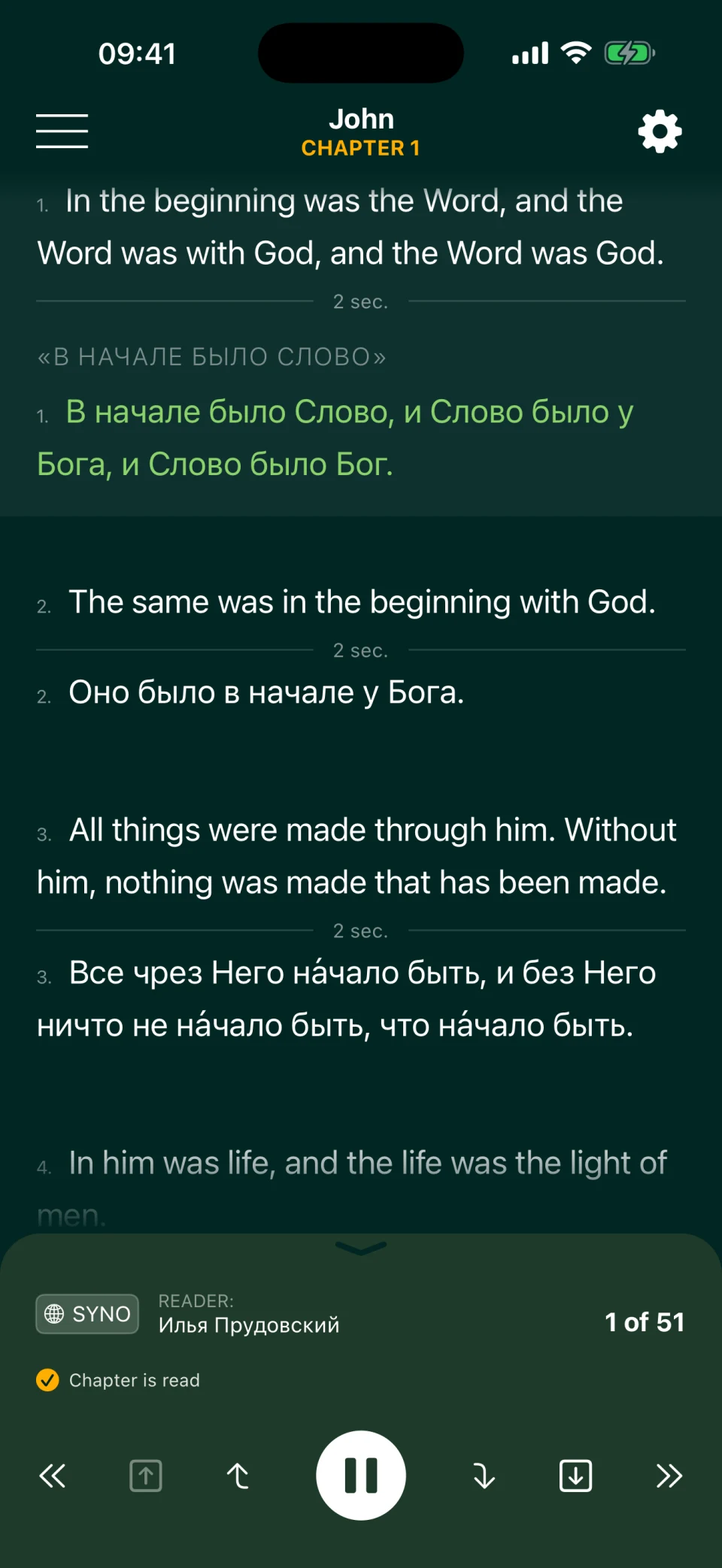
Multi Reading is Bible Garden's key feature. Build a sequence with two, three, or more translations in any combination of English, Russian, and Ukrainian. Each verse plays in the chosen order, with optional pauses between readings. The other translations appear beneath the verse on screen, and the current reading is highlighted.
The screen shows John 1 with the English BSB verse above its Russian Synodal counterpart; the player shows the Russian reader, Илья Прудовский. Try the audio example below: John 1:1–5 plays each verse first in English (BSB, read by Bob Souer), then after a two-second pause in Russian (Synodal, read by Ilya Prudovsky).
Listen to John 1:1–5 in two languages
A Berean Standard Bible (BSB) · Bob Souer
B Russian Synodal Bible · Ilya Prudovsky
- 1
In the beginning was the Word, and the Word was with God, and the Word was God.
В начале было Слово, и Слово было у Бога, и Слово было Бог.
- 2
He was with God in the beginning.
Оно было в начале у Бога.
- 3
Through Him all things were made, and without Him nothing was made that has been made.
Все чрез Него на́чало быть, и без Него ничто не на́чало быть, что на́чало быть.
- 4
In Him was life, and that life was the light of men.
В Нем была жизнь, и жизнь была свет человеков.
- 5
The Light shines in the darkness, and the darkness has not overcome it.
И свет во тьме светит, и тьма не объяла его.
You can keep listening through a book this way. Hearing a verse twice gives you a moment to notice wording you might have passed over in a single reading.
How to set up Multi Reading
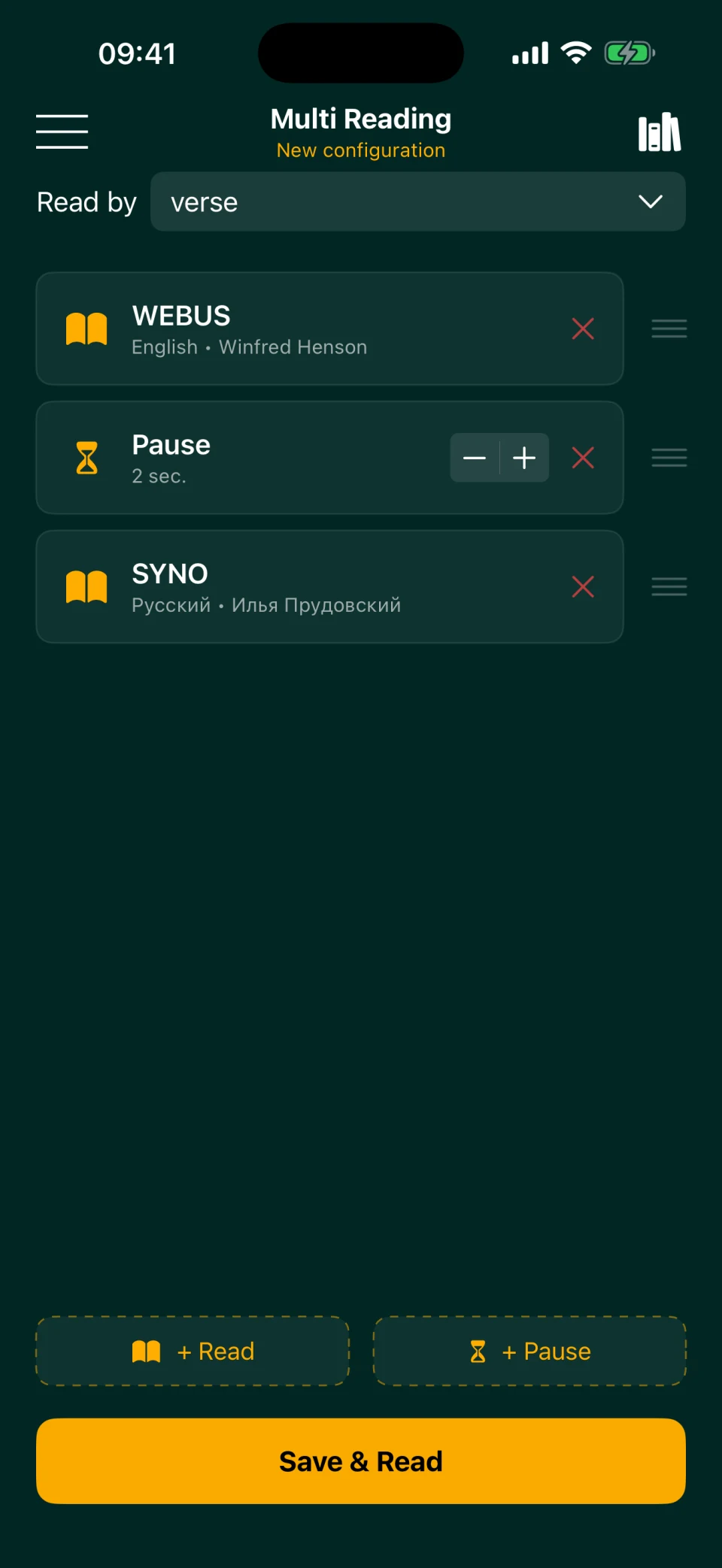
- Open Multi Reading in the app and create a new setup.
- Add a reading with a translation and narrator. The screen here starts with World English Bible, US edition (WEBUS), read by Winfred Henson.
- Add a pause. The example uses two seconds before the next language.
- Add a second reading: Russian Synodal (SYNO), read by Ilya Prudovsky.
- Choose whether to repeat the sequence for each verse, paragraph, section, or chapter. Verse by verse lets you compare the same lines directly.
A setup can include three or more translations too. For example, try BSB, WEBUS, and Russian Synodal so each verse plays three times. Save the setup to use it again with one tap.
Available translations and narrators
Bible Garden has seven translations in three languages. You can combine two, three, or more in one Multi Reading setup. Audio coverage varies: Alexander Bondarenko's recording omits four books, and the New Ukrainian Translation has audio only for the New Testament and Psalms.
| Language | Translation | Narrator | Audio coverage |
|---|---|---|---|
| Russian | Synodal | Ilya Prudovsky | All 66 books |
| Russian | Synodal | Alexander Bondarenko (with music) | 62 of 66 books |
| Russian | Kulakov translation (BTI) | Nikita Semyonov-Prozorovsky | All 66 books |
| English | Berean Standard Bible (BSB) | Bob Souer; David | All 66 books |
| English | World English Bible, US edition (WEBUS) | Winfred Henson | All 66 books |
| English | World English Bible, British edition (WEBBE) | Narrator uncredited | All 66 books |
| Ukrainian | Khomenko translation (UBH) | Ihor Kozlov | All 66 books |
| Ukrainian | New Ukrainian Translation (NPU) | Biblica; narrator uncredited | New Testament and Psalms |
“All 66 books” means the Protestant canon. The app does not include deuterocanonical books. Bondarenko's audio lacks 1 and 2 Chronicles, Song of Songs, and Isaiah.
Which English translation to choose
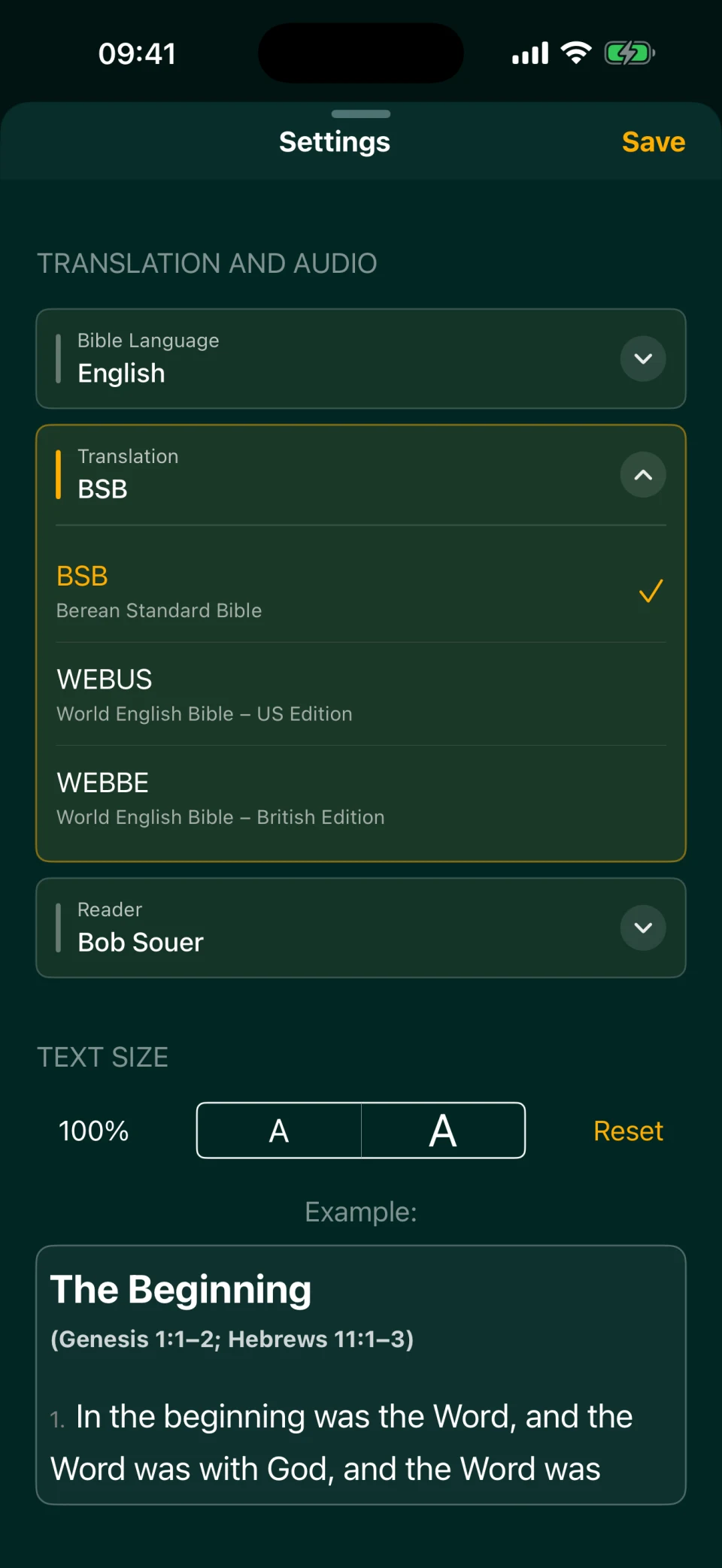
If you want a parallel Bible in English, start with two translations you can follow comfortably. The screen here shows English selected as the Bible language, with BSB, WEBUS, and WEBBE in the translation list and Bob Souer as the reader. The app offers two modern English translations, with two editions of one:
- Berean Standard Bible (BSB) uses contemporary English. You can hear it read by Bob Souer or David.
- World English Bible (WEB) also uses modern English and was placed in the public domain from the start. Its US edition (WEBUS) is read by Winfred Henson; the British edition (WEBBE) has an uncredited narrator.
Try BSB with WEBUS to compare two English renderings of a verse. For a bilingual Bible, pair either with Russian Synodal or the Kulakov translation, or with Ukrainian Khomenko — all with audio for the whole Bible. Ukrainian NPU has audio only for the New Testament and Psalms. These pairs can also help families who speak different languages and people learning one of them. The King James Version (KJV) is not in the app.
Why read the Bible in two languages?
- To understand a passage more fully. A phrase that feels unclear in English may be easier to follow in Russian or Ukrainian, and the reverse can be true. Differences can also point to a choice the translators made.
- To learn a language through a familiar text. Hear a verse in the language you know, then in the language you are learning. This gives you context for each sentence without turning the reading into a vocabulary drill.
- To read together. A family or group can follow the same passage even when some members are more at home in English and others in Russian or Ukrainian.
- To pay attention. Hearing the same verse in two voices gives you time to take in its meaning.
If you are new to the Bible, try our seven-day plan starting with John. For a full read-through, use the one-year plan. You can use Multi Reading with either plan.
Frequently asked questions
What is a bilingual Bible?
It gives the same passage in two languages, usually verse by verse, side by side or one beneath the other. It can help people read together or follow a language they are learning. In Bible Garden, you can also hear each verse in both languages.
Which parallel Bible app is the best?
That depends on which languages, translations, and ways of reading you need. Bible Garden offers English, Russian, and Ukrainian text and audio on iPhone and iPad. Multi Reading shows and plays the same verse in two, three, or more translations; it does not offer interlinear text. Check whether its available translations and narrators suit you.
Is there a Duolingo but for the Bible?
Bible Garden is a Bible reading and listening app, not a language course: it has no lessons or quizzes. Multi Reading can play a verse in a language you know and then one you are learning, so you can hear both in context. If you need a place to begin reading, try the seven-day plan in John.
Can I listen to the Bible in two languages?
Yes. In Bible Garden's Multi Reading, choose a narrator for each translation and play a verse in one language, then the same verse in another. You can add a pause between them and include a third translation or more. The app is free and available for iPhone and iPad; the languages are English, Russian, and Ukrainian.