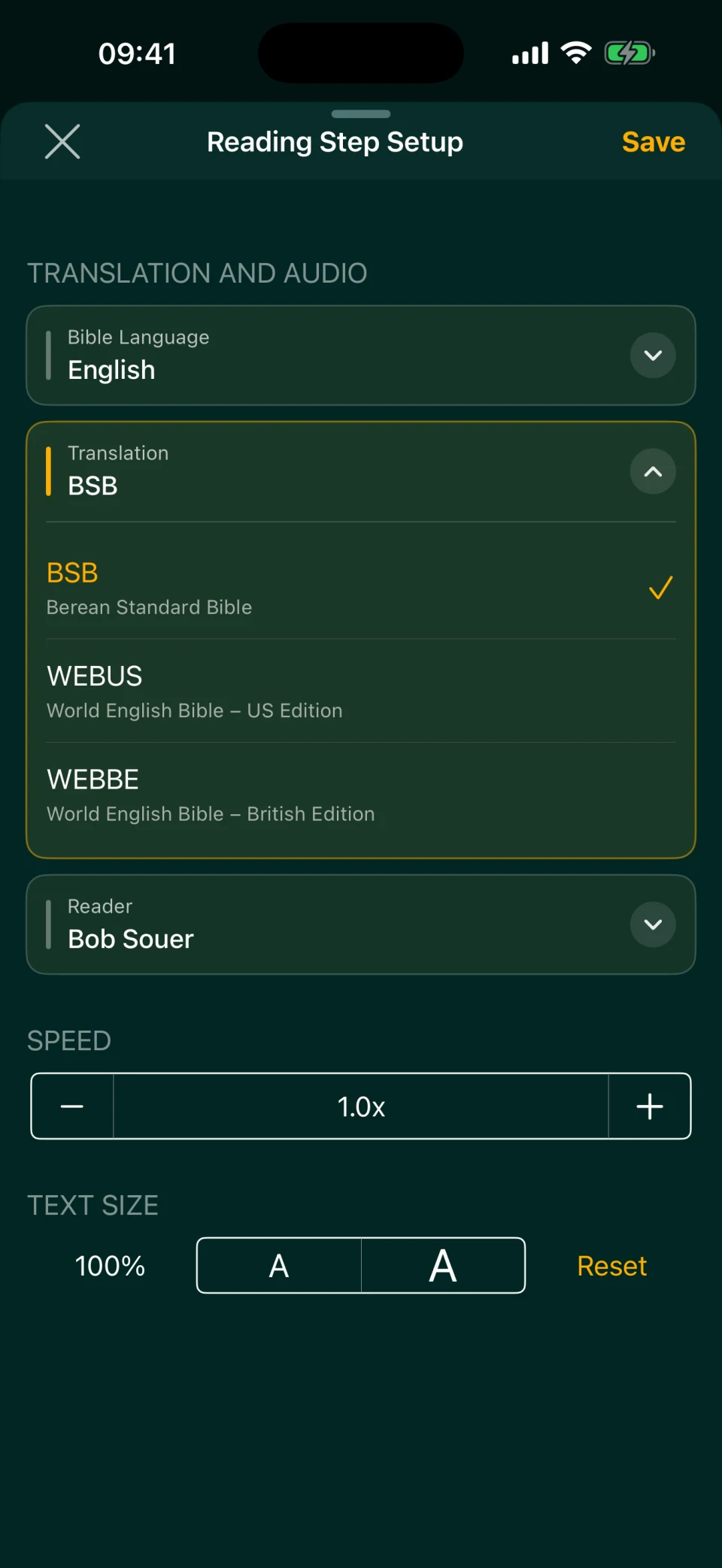
A Russian English Bible gives you the same passage in both languages, verse by verse. In the free Bible Garden app for iPhone and iPad, you can read it and also hear it: each verse plays in English, then after a short pause in Russian, all the way through the chapter. The English text is the Berean Standard Bible (BSB) or the World English Bible (WEB) in its US or British edition; the Russian text is the Synodal translation or the Kulakov translation. Every one of them has an audio recording. Below are four ready-made pairings, which language to play first, how long it takes, and where a pairing falls out of step. For what parallel and bilingual Bibles are, and to hear Multi Reading, see "Bilingual Bible App."
Four translation pairings
The two Russian translations differ more than the English ones. The Synodal translation, completed in 1876, is the Russian Bible read by Orthodox, Catholic, Baptist, and other Protestant churches alike (background); its 19th-century Russian sounds formal, much as the King James Version does in English. The Kulakov translation, completed in 2015 by the Bible Translation Institute in Zaoksky, is in modern literary Russian. So start from the Russian your family is used to.
| English | Russian | Good for |
|---|---|---|
| BSB, read by Bob Souer | Synodal, read by Ilya Prudovsky | Families where parents or grandparents grew up with the Synodal Bible and the children go to English-speaking schools |
| BSB, read by Bob Souer | Kulakov, read by Nikita Semyonov-Prozorovsky | First-time readers: both translations use contemporary language |
| WEB (US edition), read by Winfred Henson | Synodal, read by Ilya Prudovsky | Listeners who prefer Winfred Henson's voice; note the name Yahweh in the Old Testament (see below) |
| WEBBE (British edition), narrator uncredited | Kulakov, read by Nikita Semyonov-Prozorovsky | Families in the UK: the on-screen text uses British spelling |
A few differences to know before you choose:
- The divine name. The US edition of WEB uses Yahweh in the Old Testament: "Yahweh is my shepherd." BSB and the British WEBBE have Lord or LORD there, matching "Господь" in both Russian translations. If you don't want a child to hear two different names, pick BSB or WEBBE.
- The voice. BSB has two recordings, by Bob Souer and by David; the Synodal translation has two, by Ilya Prudovsky and Alexander Bondarenko. Bondarenko's recording has background music and omits four books: 1 and 2 Chronicles, Song of Songs, and Isaiah. More on the English voices is in "Audio Bible narrators."
- Copyright. BSB was dedicated to the public domain in 2023, and WEB has been public domain from the start. Both are modern English, with no thee or thou.
If your family speaks Ukrainian rather than Russian, the same approach works with the Ukrainian Khomenko translation, read by Ihor Kozlov, which has audio for all 66 books.
Which language plays first
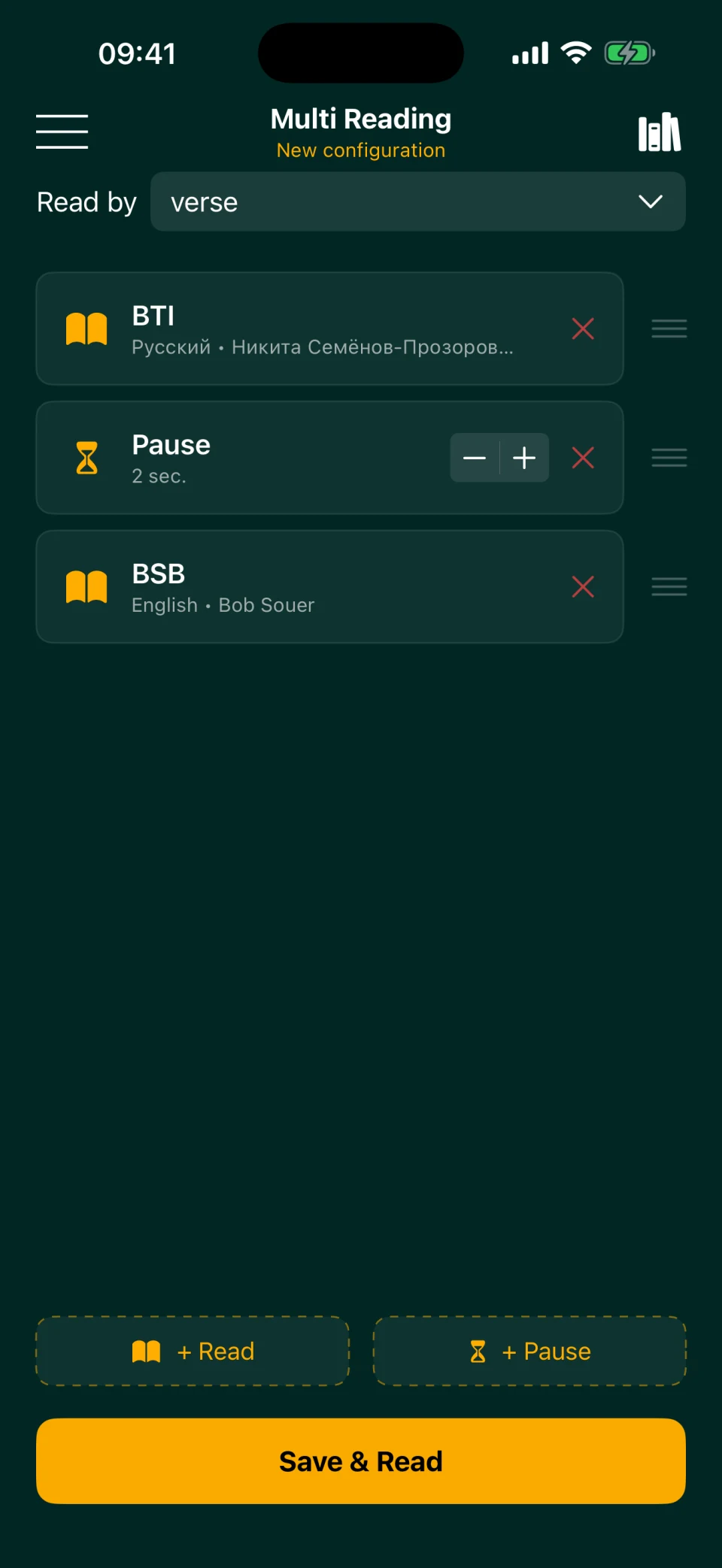
Put first the language the listener understands better. The first reading gives the meaning, so the verse in the second language is easy to follow. Children who think in English usually do best with English → Russian; parents whose first language is Russian may prefer Russian → English. Multi Reading steps can be reordered by dragging, so the same pairing flips in seconds.
You can also set these separately for each step:
- Speed, from 0.5× to 2.5× in steps of 0.1. For example, keep Russian at 1× and speed up the more familiar English to 1.2×. Multi Reading has no single speed control; each step has its own.
- Text size for each translation on screen.
- Pauses, a separate step of 1 to 60 seconds (2 by default). Put one after each reading or only after the pair.
If family members listen differently, save more than one template, such as "Kids: English → Russian" and "Mom: Russian → English." Templates are stored on the device and load with one tap. You can add a third translation too, say BSB, Synodal, and Kulakov, and each verse plays three times.
By verse, paragraph, or chapter
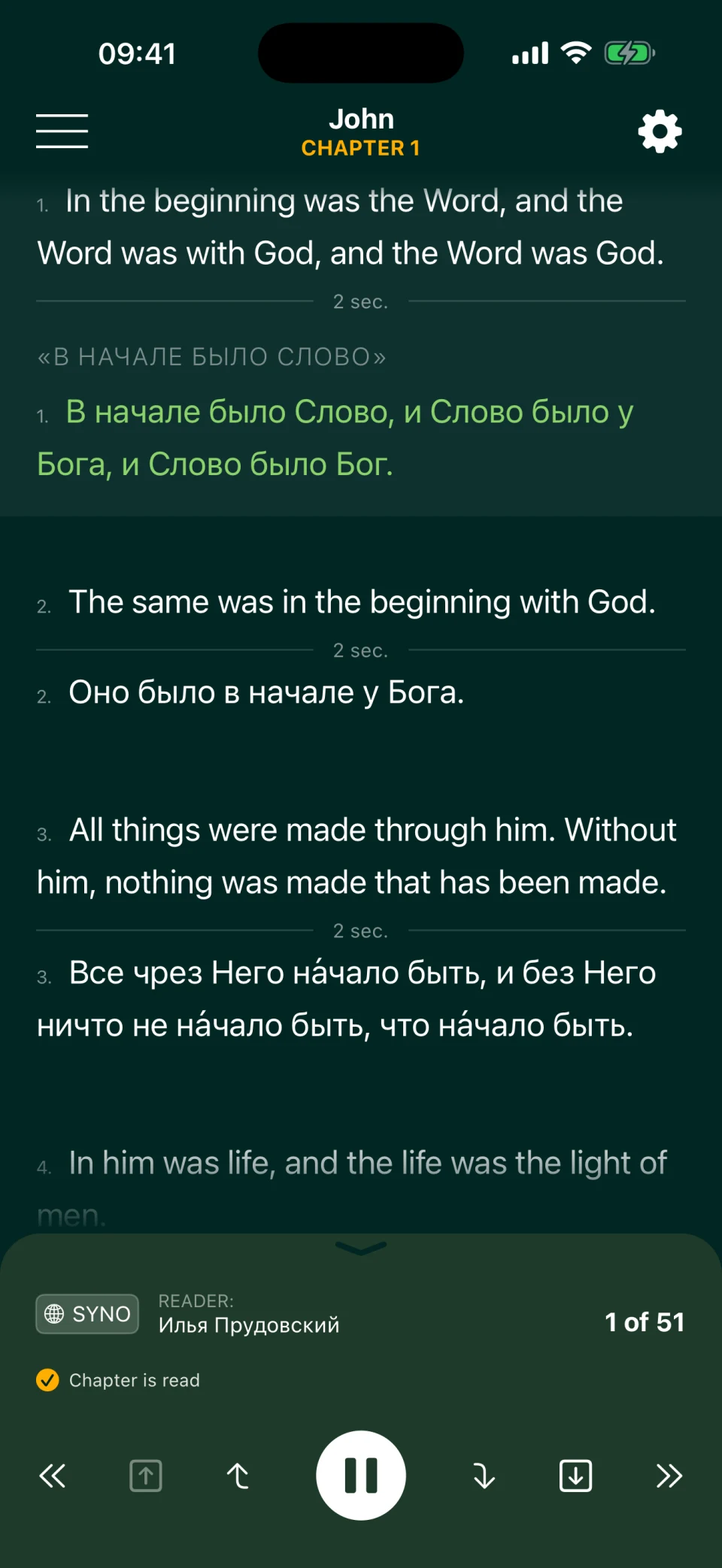
Multi Reading is Bible Garden's key feature. A verse plays in English, then the same verse in Russian, and both texts appear on screen under each verse, with the current reading highlighted. You can alternate by verse, paragraph, section, or chapter.
Here is how the BSB and Synodal pairing sounds: the opening of John read by Bob Souer and Ilya Prudovsky.
Listen to John 1:1–5 in two languages
A Berean Standard Bible (BSB) · Bob Souer
B Russian Synodal Bible · Ilya Prudovsky
- 1
In the beginning was the Word, and the Word was with God, and the Word was God.
В начале было Слово, и Слово было у Бога, и Слово было Бог.
- 2
He was with God in the beginning.
Оно было в начале у Бога.
- 3
Through Him all things were made, and without Him nothing was made that has been made.
Все чрез Него на́чало быть, и без Него ничто не на́чало быть, что на́чало быть.
- 4
In Him was life, and that life was the light of men.
В Нем была жизнь, и жизнь была свет человеков.
- 5
The Light shines in the darkness, and the darkness has not overcome it.
И свет во тьме светит, и тьма не объяла его.
Choose the unit by what you want from the reading:
- By verse suits family reading and anyone less at home in one of the languages: the phrase is still in your ear when its translation begins. It works for language learners too.
- By paragraph keeps the story flowing instead of breaking it into short lines. Order matters here: the app takes paragraph breaks from the first translation. The Synodal translation has few of them, about 3,000 in the whole Bible, compared with about 8,000 in Kulakov and nearly 16,000 in BSB. Put BSB or Kulakov first for paragraph mode; with Synodal first, a "paragraph" often runs for half a chapter.
- By chapter plays the whole chapter in one language, then in the other. It's for listeners who understand both languages well and want to hear each chapter twice.
How long it takes
A pairing takes about as long as both recordings back to back, plus pauses. The times below are for verse-by-verse listening at 1× with a two-second pause after each reading. They are calculated from the app's audio files, measured on October 4, 2026: for each translation we added up the spoken verse segments and the pauses, the same way our calculator does. Actual listening time may differ slightly.
| Pairing | Whole Bible | Minutes a day to finish in a year | New Testament | Gospel of John |
|---|---|---|---|---|
| BSB (Souer) + Synodal (Prudovsky) | 191 hours | 31 | 46 hours | 5.1 hours |
| WEB (Henson) + Synodal (Prudovsky) | 205 hours | 34 | 48 hours | 5.2 hours |
| WEBBE + Kulakov (Semyonov-Prozorovsky) | 209 hours | 34 | 49 hours | 5.4 hours |
| BSB (Souer) + Kulakov (Semyonov-Prozorovsky) | 212 hours | 35 | 51 hours | 5.5 hours |
Chapter by chapter, each pairing takes 22–23 hours less, because there are far fewer pauses. BSB with Ukrainian Khomenko takes about 194 hours verse by verse. A good place to start is a Gospel: one chapter of Mark or John takes about 15 minutes as a pair. To work out your own pace, speed, and pauses, use the calculator in "How Long Does It Take to Read the Bible?," which has a Multi Reading mode.
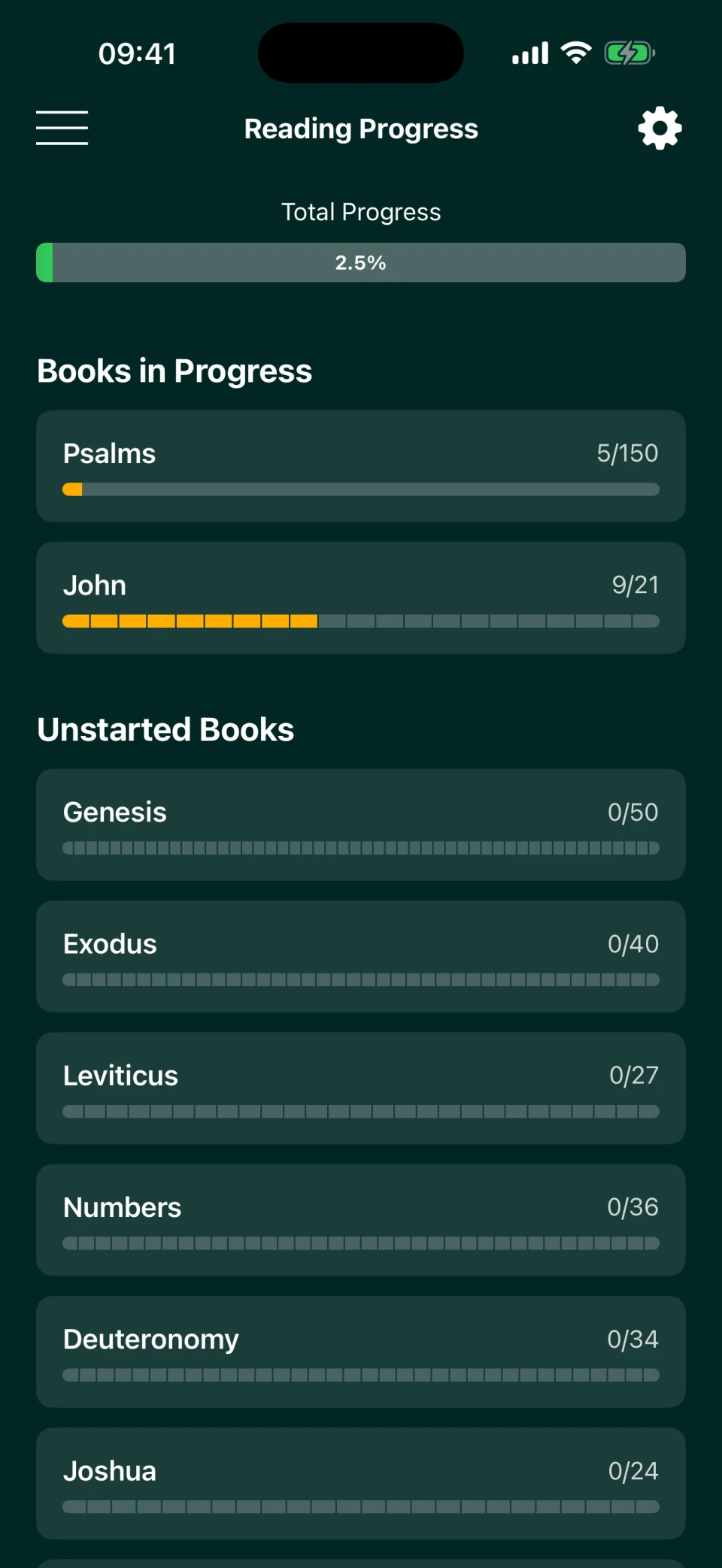
The app marks chapters as read automatically, in Multi Reading too, and the progress screen shows how many books you've finished.
The Psalms and other places where numbering differs
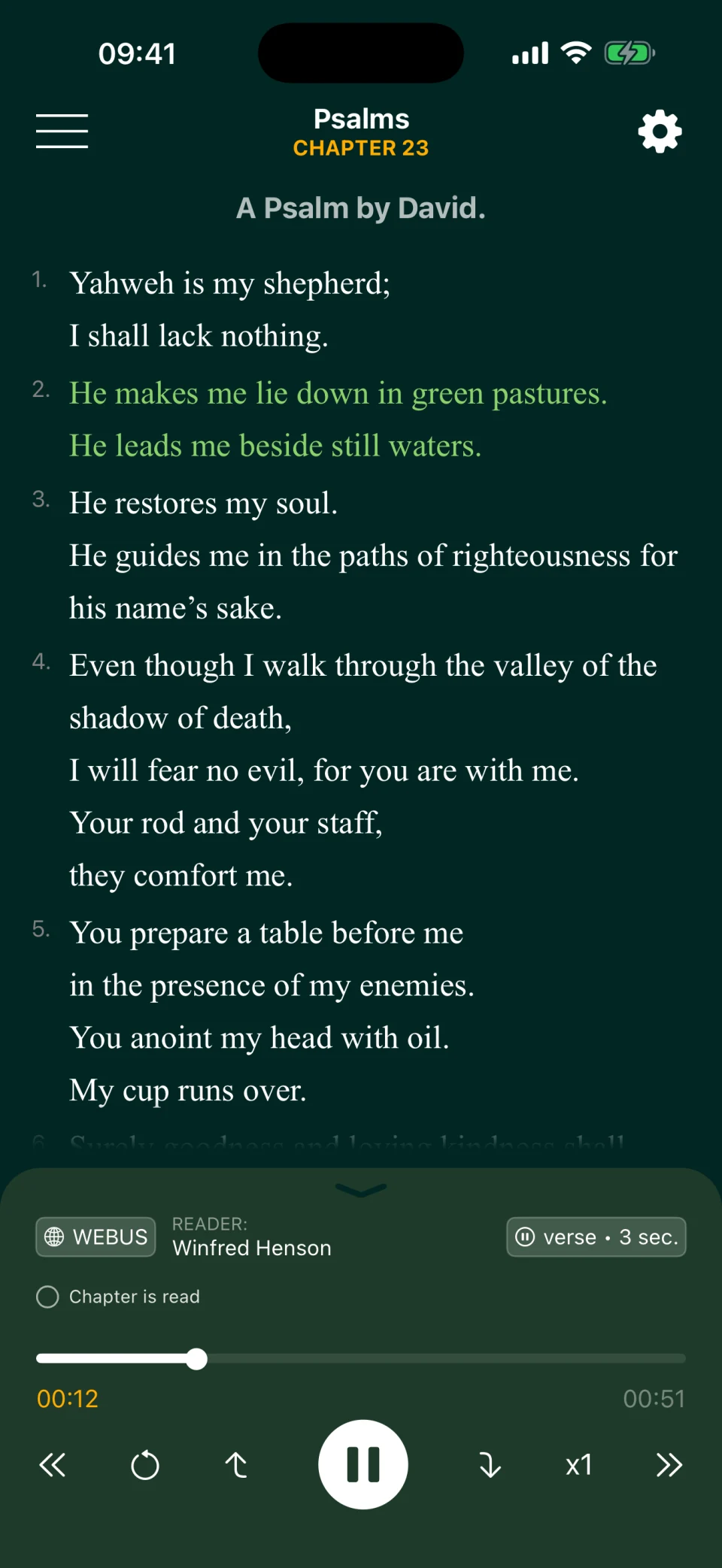
English translations number the Psalms after the Hebrew text, while the Synodal and Kulakov translations follow the Greek Septuagint. For most psalms, the Russian number is one lower: "The Lord is my shepherd" is Psalm 23 in English and Psalm 22 in Russian (why the numbering differs). Russian translations also often count a psalm's heading as a separate verse.
Multi Reading takes the chapter with the same number from each translation and lines up the verses in order: first with first, second with second. A pairing stays in step only when chapters and verses are divided the same way. In the Psalms they aren't: open Psalm 22 and you'll hear "My God, my God" in English but "Господь — Пастырь мой" (The Lord is my shepherd) in Russian. The Synodal and English translations have the same number of verses in only 13 of the 150 psalms (based on the texts in the app, October 2026). What to do instead:
- Listen to the Psalms in each language separately in Classic Reading: English Psalm 23, then Russian Psalm 22.
- Or pair the two Russian translations. Synodal and Kulakov share the same numbering, and their verse counts differ in only three psalms.
The Ukrainian Khomenko translation numbers the psalms as English Bibles do, but often counts the heading as verse 1, so in many psalms with a heading the Ukrainian verses run one or two ahead of the English.
Elsewhere the division is almost the same: verse counts in Synodal and BSB differ in 49 of the 1,039 chapters outside the Psalms, and in Kulakov and BSB in 74. For example, the end of Romans (Romans 16:25–27 in English Bibles) stands at the end of chapter 14 in the Synodal translation. In such chapters, the second translation runs behind or ahead from that point, and at the end of the chapter its last verse may repeat or a few verses may not play.
Frequently asked questions
Which English translation pairs best with the Russian Synodal Bible?
BSB read by Bob Souer is the simplest choice: it's modern English, and in the Old Testament it has Lord where the Synodal text has "Господь." If you'd like a different voice, WEB read by Winfred Henson also works, but its Old Testament uses the name Yahweh.
Can I hear English first and then Russian?
Yes. Multi Reading steps can be reordered by dragging, and you can save different orders as separate templates, for example one for parents and one for children.
How long does it take to listen to the whole Bible in Russian and English?
For the four pairings above, verse by verse at 1× with a two-second pause after each reading, our calculation gives 191 hours (BSB read by Bob Souer with the Synodal translation read by Ilya Prudovsky) to 212 hours (BSB with the Kulakov translation). To finish in a year, that's 31–35 minutes a day.
Why don't the Psalms match in a Russian English pairing?
Russian translations number the Psalms after the Greek Septuagint and English ones after the Hebrew text, so most psalm numbers differ by one. Multi Reading pairs chapters with the same number and lines up the verses in order, so listen to the Psalms in each language separately.
Can I listen on Android or on a computer?
Not yet: Bible Garden runs on iPhone and iPad. A web version for listening on the site and an Android app are in our plans.