The Bible works well for learning English because many learners already know its stories. You know what happens, so you can focus on how it is said. The method takes three steps per chapter:
- Understand: each verse plays twice, in two English wordings or at two speeds.
- Listen: play the same chapter once in English, following the text with your eyes.
- Repeat: say a few verses aloud after the narrator.
Start with the Gospel of John in the Berean Standard Bible (BSB), a modern translation. You can do all of this in the free Bible Garden app for iPhone and iPad. Below: how to set up each step, which English translation is easier, a 30-day plan, and famous Bible verses with their best-known idioms.
Why the Bible works for learning English
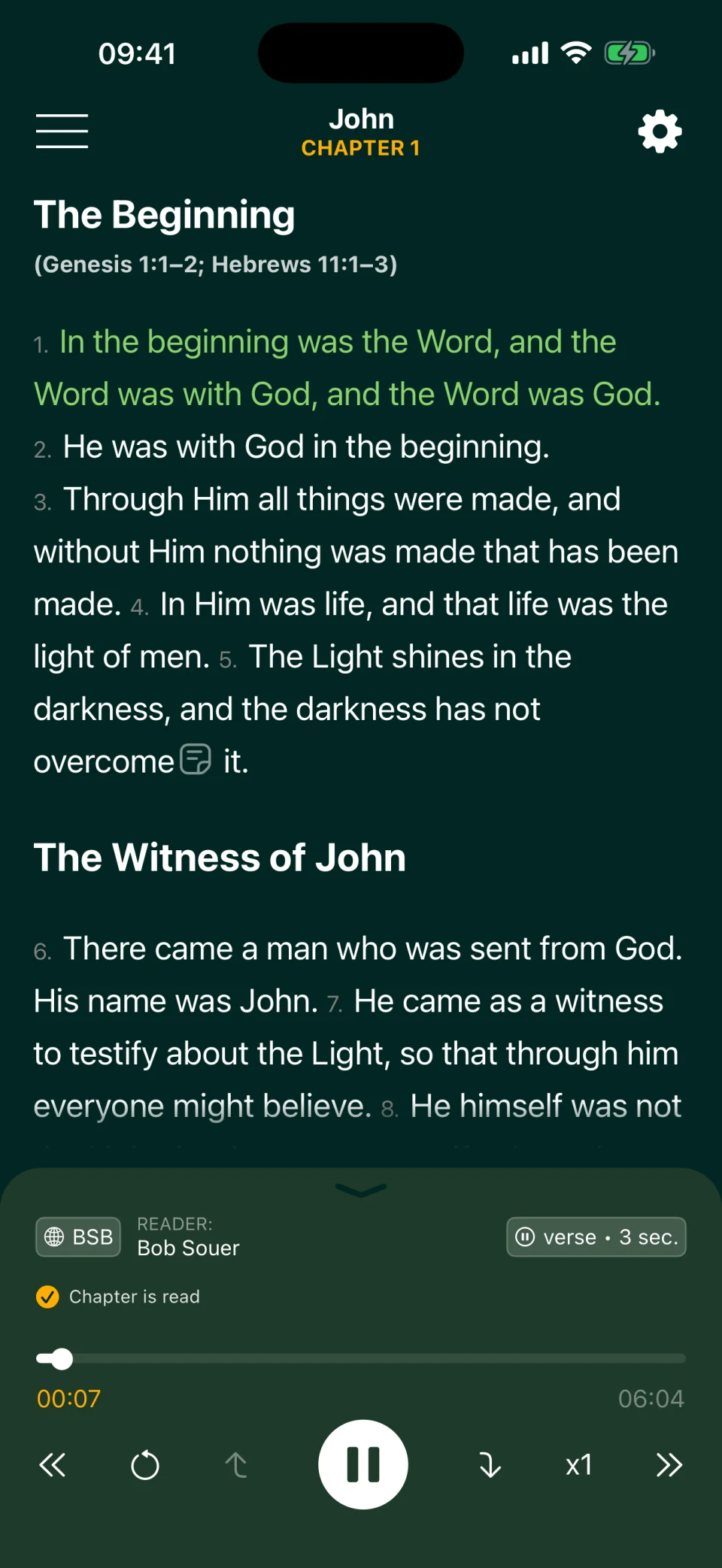
- A familiar text. When you know what a chapter is about, you can often guess a new word from context instead of reaching for a dictionary.
- Short pieces. A verse is one or two sentences, easy to replay and repeat.
- Audio that matches the text. Every English translation in the app has a complete recording, and you can follow the words as you listen.
That last point matters. In a study by Brown, Waring, and Donkaewbua (2008), intermediate learners recognized the meaning of 48% of new words on a multiple-choice test after reading while listening, 45% after reading, and 29% after listening alone. Still, most words were not learned, and words that appeared more often were remembered better. So go through the same passage more than once.
One caveat: Bible English is not everyday English. You'll meet words like disciples and righteousness and few words for daily life, so the Bible works best alongside a course, not instead of one.
A three-step method for each chapter
Multi Reading is Bible Garden's key feature. It plays each verse in several translations in a row, with pauses you choose. Every translation of the verse appears on screen, and the one being read is highlighted.
Here is John 1:1–5 in the two English translations: BSB read by Bob Souer, then the World English Bible (WEB) read by Winfred Henson.
Listen to John 1:1–5 in two translations
A Berean Standard Bible (BSB) · Bob Souer
B World English Bible (WEB) · Winfred Henson
- 1
In the beginning was the Word, and the Word was with God, and the Word was God.
In the beginning was the Word, and the Word was with God, and the Word was God.
- 2
He was with God in the beginning.
The same was in the beginning with God.
- 3
Through Him all things were made, and without Him nothing was made that has been made.
All things were made through him. Without him, nothing was made that has been made.
- 4
In Him was life, and that life was the light of men.
In him was life, and the life was the light of men.
- 5
The Light shines in the darkness, and the darkness has not overcome it.
The light shines in the darkness, and the darkness hasn’t overcome it.
Step 1. Understand. In Multi Reading, add BSB, a 2-second pause, and WEB, and choose to read by verse. Two wordings of the same idea often explain each other: one says "worry," the other "be anxious." A chapter of John takes about 11 minutes this way at 1× speed. You can also add BSB twice, slower and then at normal speed (see below). If Russian or Ukrainian is your first language, put a translation in that language first; Bilingual Bible App shows that setup. With such a pair, listen to Psalms separately in Classic Reading: their verse numbering differs from English Bibles, so the paired verses don't match.
Step 2. Listen. Play the same chapter in Classic Reading, in English only, and follow the text. Bob Souer reads a chapter of John in about 5 minutes on average.
Step 3. Repeat. Pick 5–10 verses you like and say them aloud after the narrator; the next section shows how.
Repeat aloud: pause after every verse
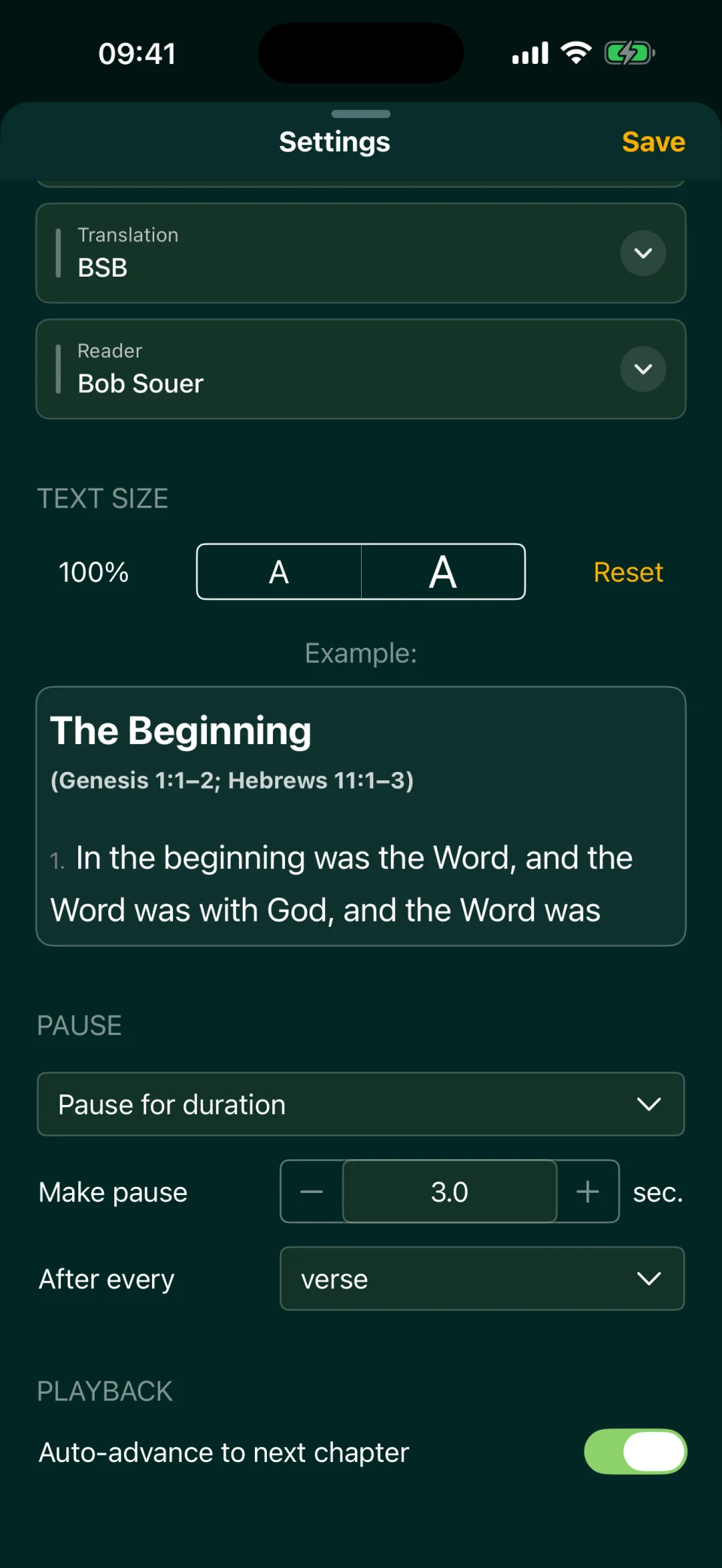
Start simply: a verse plays, and you repeat it aloud during the pause. Once a verse feels familiar, try shadowing: speak along with the narrator, a word or two behind. In a study by Yo Hamada (2016), learners who practiced shadowing perceived English sounds more accurately, while listening comprehension scores improved only in the lower-proficiency group. It helps you hear the language; it is not a shortcut.
How to set it up in Bible Garden:
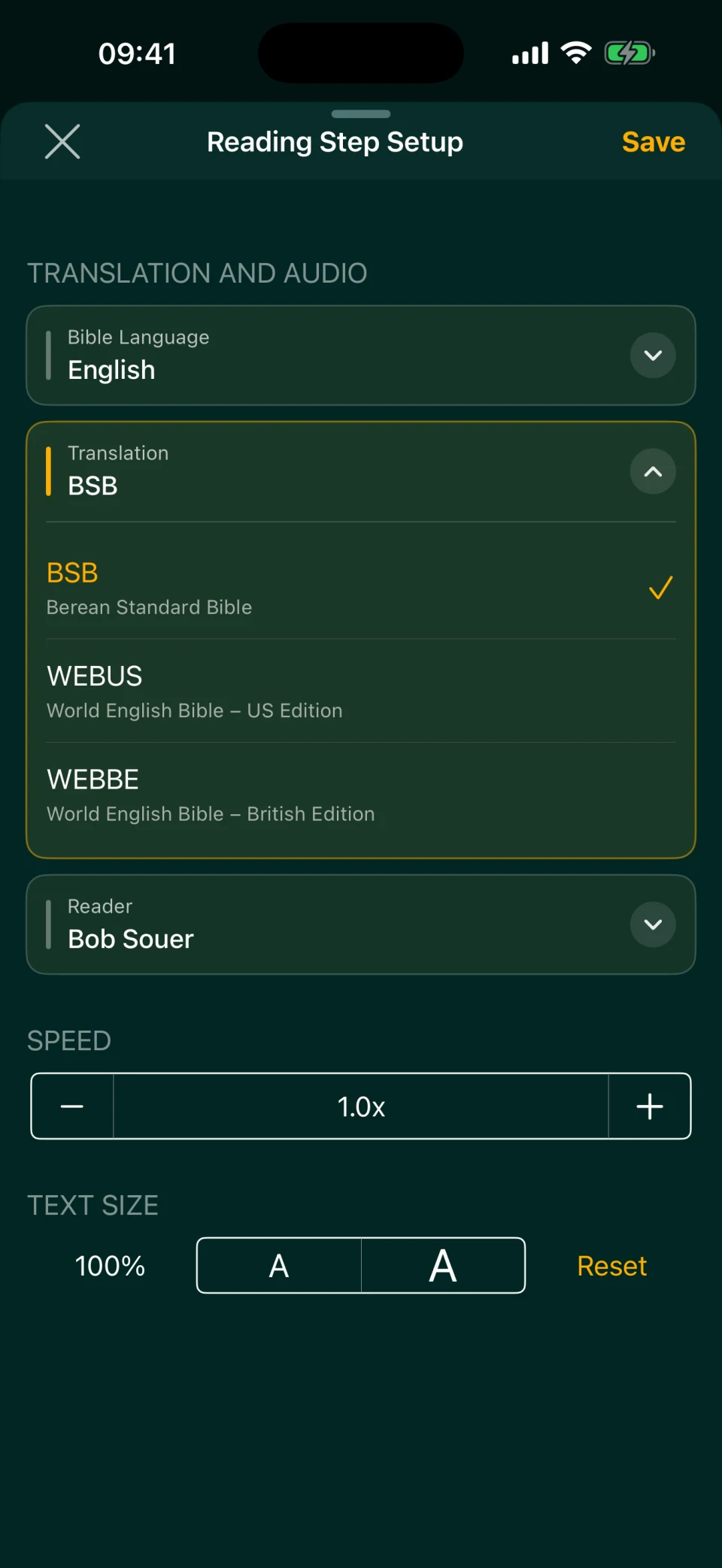
- In Classic Reading, add a pause after every verse: a few seconds, or until you tap Play. A verse plays, you repeat it, you tap Play.
- In Multi Reading, add a longer pause after the English reading, 5–8 seconds, so you can repeat without touching the screen. To hear a verse twice, add the same translation as two steps: BSB, a pause, BSB again.
- If you missed something, the previous-verse button takes you back to the exact start of the previous verse. The app has no separate repeat button.
For shadowing, choose short verses and start at a slower speed.
Slow it down: speed and voices
For a beginner, the hard part is often keeping up rather than knowing the words. In an experiment by Yong Zhao (1997), listeners learning English understood more when they controlled the speech rate themselves, and they mostly slowed it down.
The app has four English recordings, each with its own pace. We measured it across each full Bible recording: the translation's word count divided by the audio length (app data as of October 4, 2026).
| Translation | Narrator | Words per minute |
|---|---|---|
| WEB, US edition | Winfred Henson | about 148 |
| BSB | David | about 154 |
| BSB | Bob Souer | about 175 |
| WEBBE, British edition | narrator not credited | about 190 |
What you can adjust:
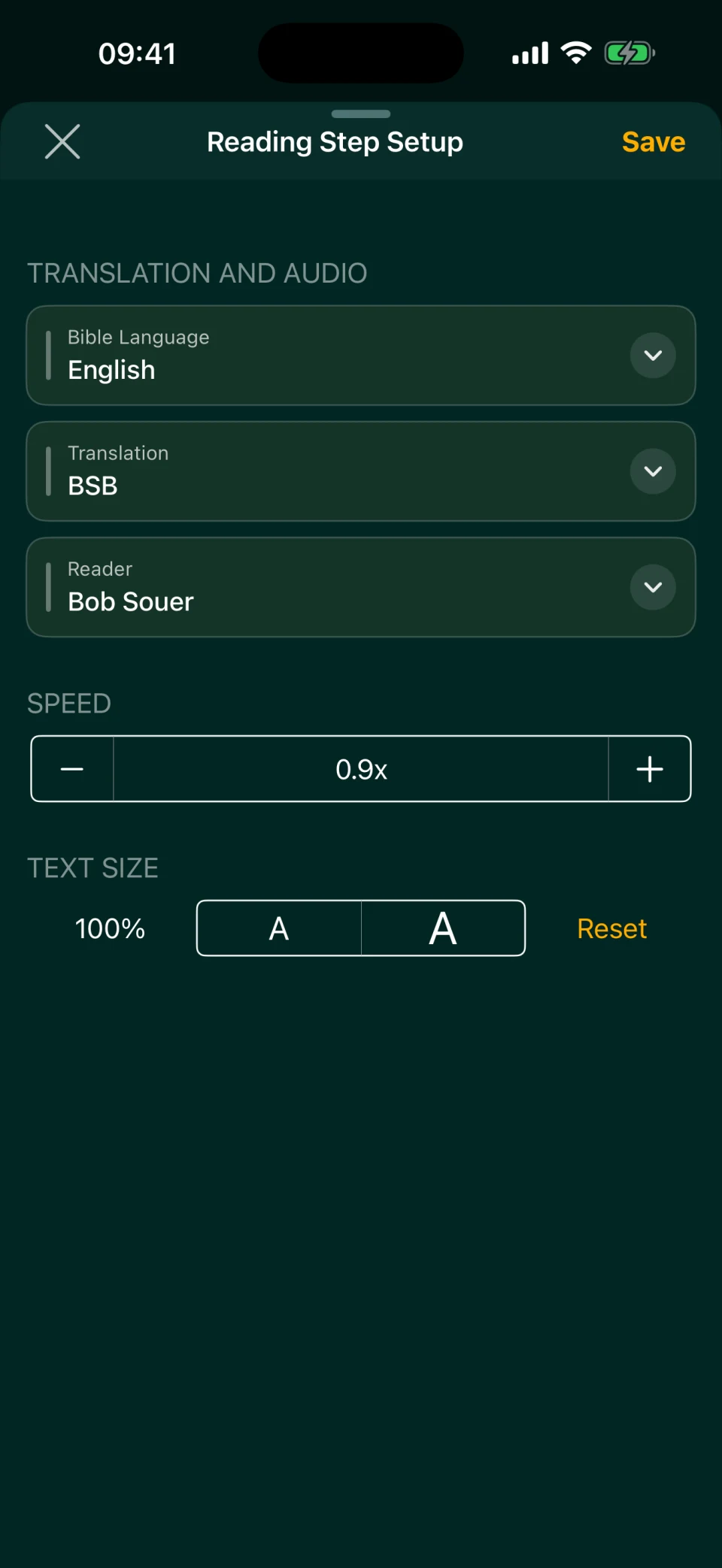
- Speed in Classic Reading: 0.6× to 2.0× in steps of 0.2. At 0.8×, Bob Souer reads at about 140 words per minute.
- Speed in Multi Reading is set for each step, from 0.5× to 2.5× in steps of 0.1. There is no single speed button there.
- One verse twice. BSB at 0.7×, a pause, then BSB at 1×. Or BSB read by David, then by Bob Souer: the same words in two voices.
Choose an English narrator
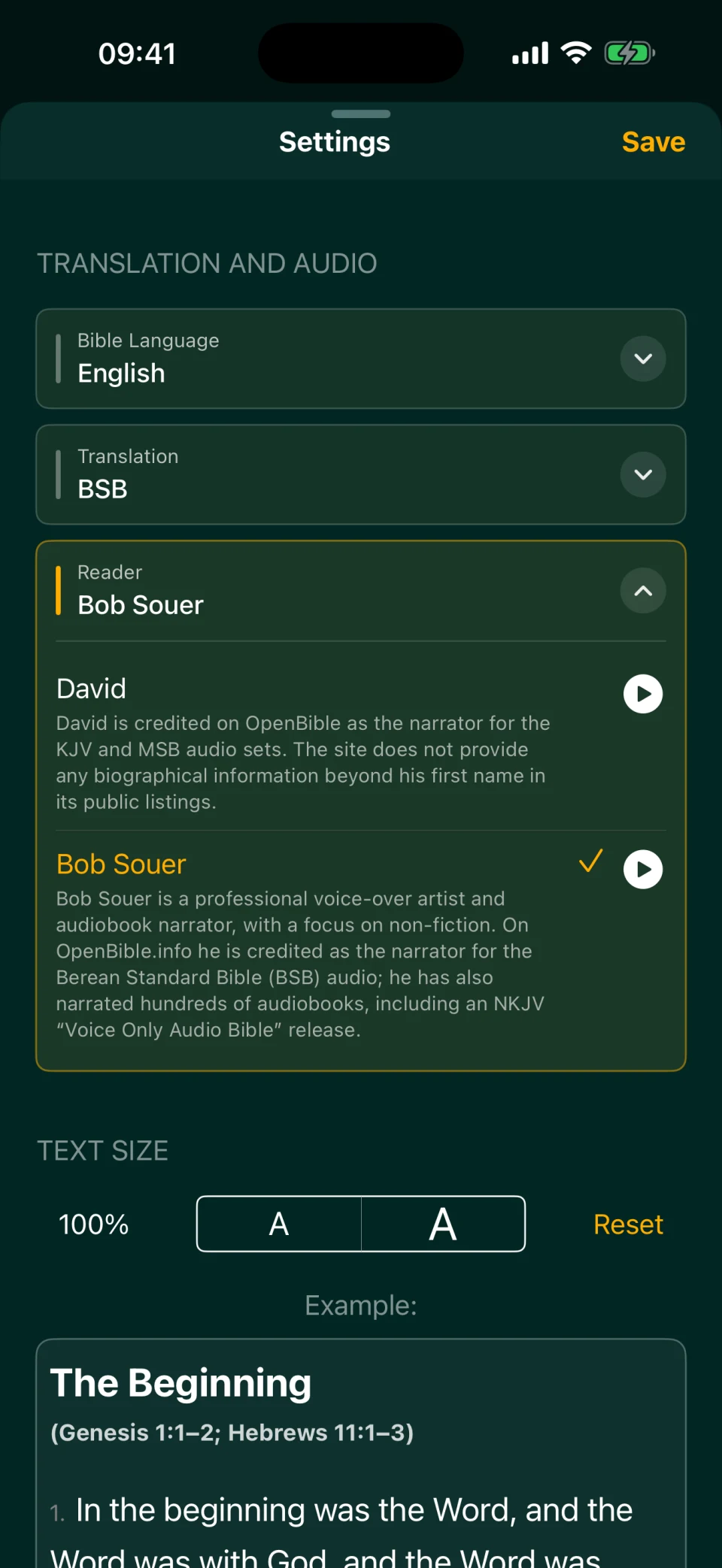
Hear a voice first. Before choosing a narrator, you can play a sample, John 1:1–3. More about each voice: Audio Bible narrators.
BSB or WEB: which English is easier?
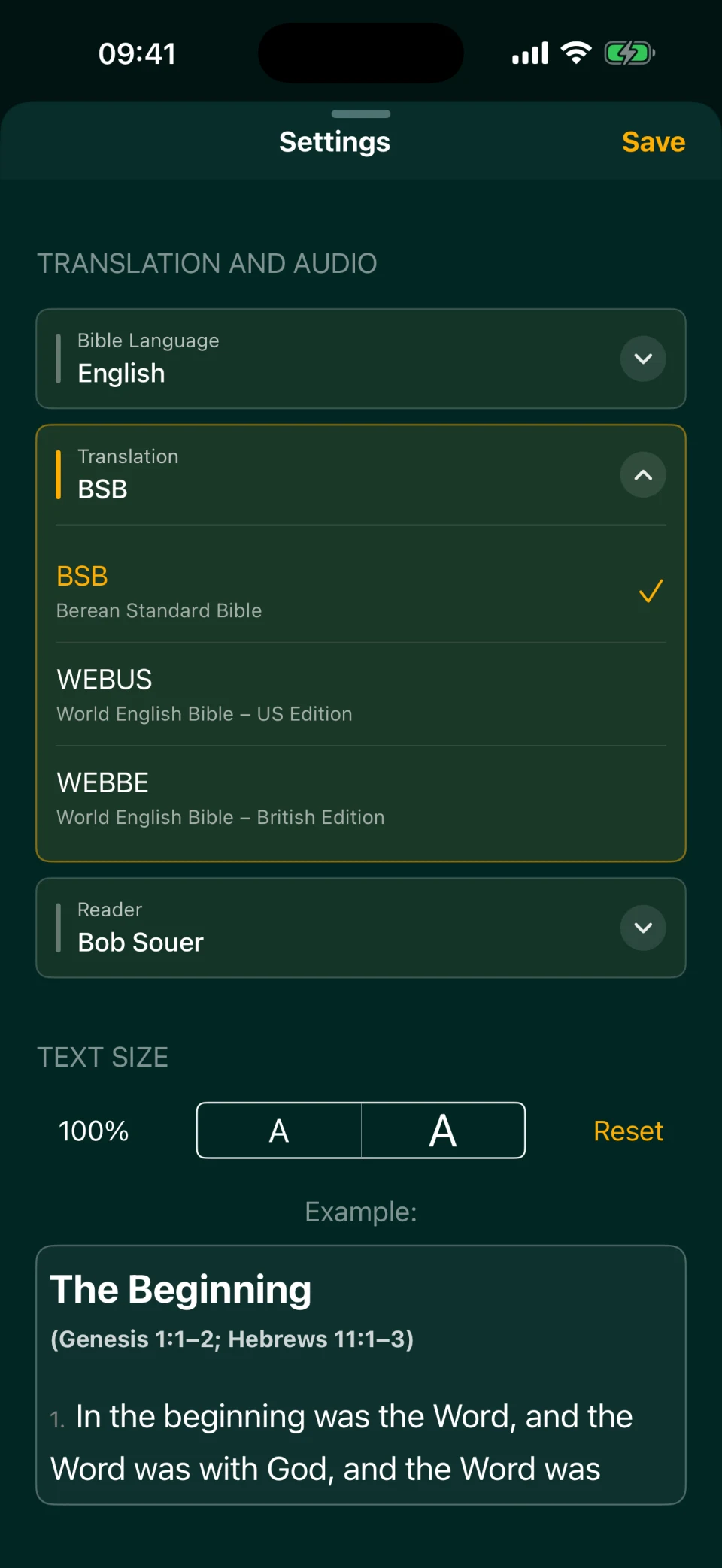
Both are modern translations without thee and thou, and both are free of copyright: BSB was dedicated to the public domain in 2023, and WEB has been public domain from the start. They still sound different.
| BSB | WEB | |
|---|---|---|
| Basis | A new translation | An update of the 1901 American Standard Version |
| Style | Smooth, contemporary English | More old-fashioned turns of phrase, but more contractions |
| "Behold" in the New Testament | 29 times | 214 times |
| "don’t" in the New Testament | 9 times | 484 times |
| God's name in the Old Testament | Lord | Yahweh in the US edition, LORD in the British |
Compare Matthew 6:34:
- BSB: Therefore do not worry about tomorrow, for tomorrow will worry about itself. Today has enough trouble of its own.
- WEB: Therefore don’t be anxious for tomorrow, for tomorrow will be anxious for itself. Each day’s own evil is sufficient.
Start with BSB. Once you're comfortable, pair BSB with WEB in Multi Reading to collect synonyms and see different ways to build a sentence. For a wider comparison with KJV, NIV, and other versions, see Which Bible Translation Is Best?
One difference matters in Multi Reading, which pairs verses by position: first with first, second with second. In the Gospels, BSB leaves out 11 verses that are missing from some early manuscripts, such as John 5:4 and Mark 9:44 and 46; WEB keeps them. From that point on, the two translations in a pair drift apart. This happens in 10 of the 89 Gospel chapters. In those chapters, use BSB twice instead of BSB with WEB.
Famous Bible verses in English
Ten well-known verses in both English translations, exactly as they appear in the app.
| Verse | BSB | WEB (US edition) |
|---|---|---|
| Genesis 1:1 | In the beginning God created the heavens and the earth. | In the beginning, God created the heavens and the earth. |
| Psalm 23:1 | The Lord is my shepherd; I shall not want. | Yahweh is my shepherd; I shall lack nothing. |
| Psalm 119:105 | Your word is a lamp to my feet and a light to my path. | Your word is a lamp to my feet, and a light for my path. |
| Proverbs 3:5 | Trust in the Lord with all your heart, and lean not on your own understanding; | Trust in Yahweh with all your heart, and don’t lean on your own understanding. |
| Ecclesiastes 3:1 | To everything there is a season, and a time for every purpose under heaven: | For everything there is a season, and a time for every purpose under heaven: |
| Matthew 7:12 | In everything, then, do to others as you would have them do to you. For this is the essence of the Law and the Prophets. | Therefore, whatever you desire for men to do to you, you shall also do to them; for this is the law and the prophets. |
| John 1:5 | The Light shines in the darkness, and the darkness has not overcome it. | The light shines in the darkness, and the darkness hasn’t overcome it. |
| John 3:16 | For God so loved the world that He gave His one and only Son, that everyone who believes in Him shall not perish but have eternal life. | For God so loved the world, that he gave his only born Son, that whoever believes in him should not perish, but have eternal life. |
| 1 Corinthians 13:13 | And now these three remain: faith, hope, and love; but the greatest of these is love. | But now faith, hope, and love remain — these three. The greatest of these is love. |
| Philippians 4:13 | I can do all things through Christ who gives me strength. | I can do all things through Christ who strengthens me. |
The Bible has also shaped everyday English. Linguist David Crystal counted 257 idioms that entered the language through the King James Bible, twice as many as Shakespeare introduced; most of them already appeared in earlier 16th-century English Bibles (NPR, 2010). The King James Version is not in the app, but these BSB passages show where the idioms come from:
| Idiom | Meaning | Source (BSB) |
|---|---|---|
| the salt of the earth | good, honest, dependable people | Matthew 5:13: You are the salt of the earth. |
| by the skin of your teeth | only just, barely | Job 19:20: I have escaped by the skin of my teeth. |
| a drop in the bucket | a tiny amount compared with what is needed | Isaiah 40:15: the nations are like a drop in a bucket |
| go the extra mile | do more than is expected | Matthew 5:41: if someone forces you to go one mile, go with him two miles. |
| nothing new under the sun | it has all happened before | Ecclesiastes 1:9: there is nothing new under the sun. |
A 30-day plan
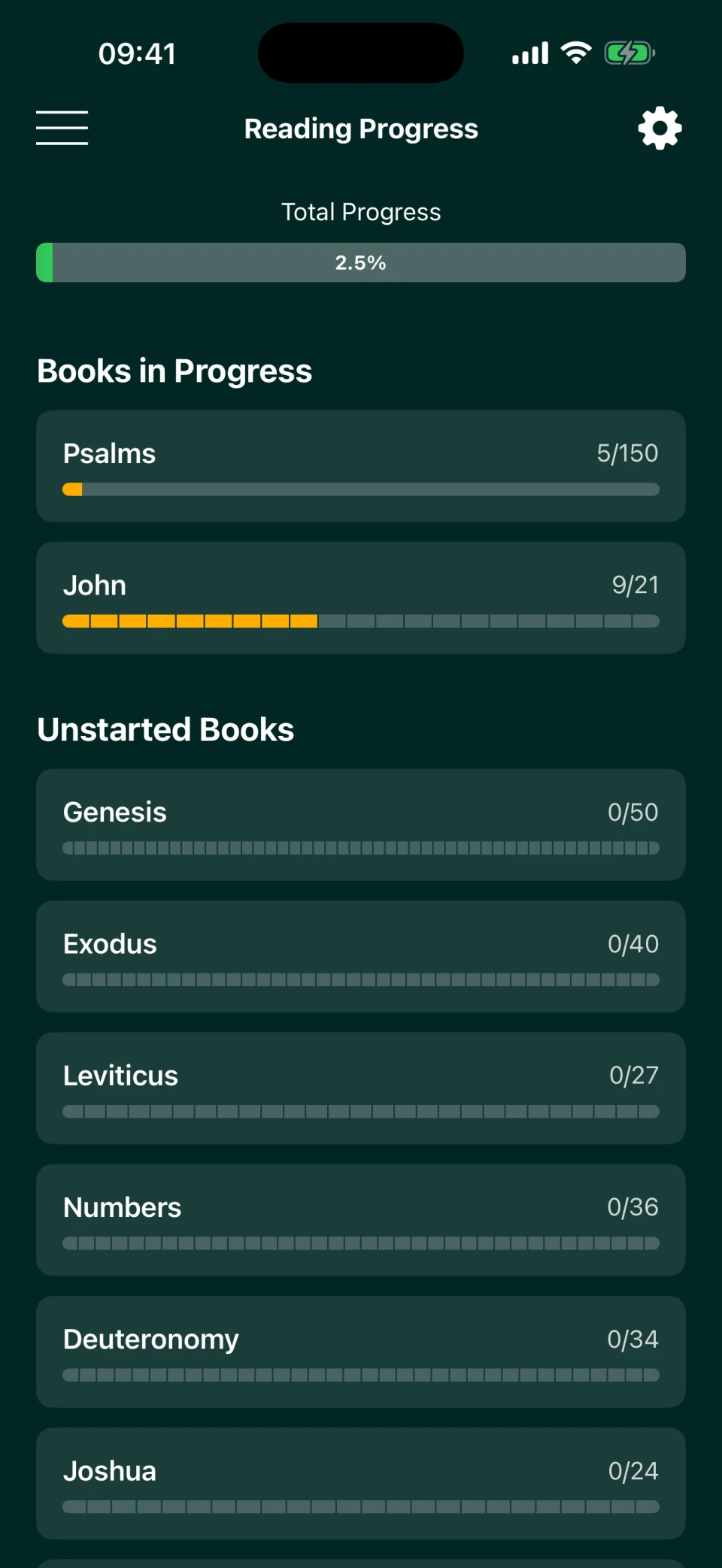
The Gospel of John has 21 chapters, plain language, and the same key words again and again: light, life, truth, believe, love. After it comes 1 John, a short letter with the same vocabulary.
| Days | Read | How |
|---|---|---|
| 1–7 | John 1–7 | Step 1: Multi Reading, BSB then WEB |
| 8–14 | John 8–14 | Steps 1 and 2: the pair, then the same chapter in English only |
| 15–21 | John 15–21 | All three steps, plus 5–10 verses aloud |
| 22–26 | 1 John 1–5 | Listen once with the text; use Multi Reading only if you got lost |
| 27–30 | Your favorite chapters of John | Listen without the text: how much do you understand by ear? |
In John 5, BSB and WEB drift apart, so for that chapter use BSB twice, slow and then at normal speed.
Bible Garden has no reading plans or reminders, but it marks chapters as read automatically, in Multi Reading too, and the progress screen shows the books you've finished. To make it a habit, see How to Read the Bible Every Day.
Frequently asked questions
Can you learn English just by reading the Bible?
No. The Bible gives you a lot of listening material you can understand, but its vocabulary is far from everyday English. A course or textbook covers grammar and daily words; the Bible gives you daily practice.
What level of English do I need?
It helps to know basic grammar and the most common words; complete beginners should start with a course. Multi Reading lowers the bar: a second wording explains the first, and a slower speed gives you time to catch each word.
Which Bible translation is best for ESL learners?
Start with the Berean Standard Bible (BSB): smooth modern English and two recordings, by Bob Souer and David. Add the World English Bible (WEB) as a second translation to compare wordings. In Bible Garden, both play verse by verse with the text on screen.
Is there a Bible in British English?
Yes, the British edition of the World English Bible (WEBBE) uses British spelling. Its narrator is not credited, and at about 190 words per minute it is the fastest English recording in the app, so slow it down at first.
How can I teach English using the Bible?
Use the same three steps in class: play a verse, pause, and have students repeat it; then compare how BSB and WEB word it. Familiar stories such as the parables work well. Bible Garden is a personal app with no classroom features, so play it from one device through a speaker.
Does Bible Garden work on Android or a computer?
Not yet: Bible Garden runs on iPhone and iPad. A web version for listening on the site and an Android app are in our plans.